• About
  • Special Reports
  • Topics
    • Climate
    • Earth Science
    • Oceans
    • Space & Planets
    • Health & Ecosystems
    • Culture & Policy
    • Education & Careers
    • Opinions
  • Projects
    • Postcards From the Field
    • ENGAGE
    • Editors’ Highlights
    • Editors’ Vox
    • Eos en Español
    • Eos 简体中文版
    • Print Archive: 2015–2025
  • Policy Tracker
  • Blogs
    • Research & Developments
    • The Landslide Blog
  • Newsletter
  • Submit to Eos
  • AGU.org
  • Career Center
  • Join AGU
  • Give to AGU
  • About
  • Special Reports
  • Topics
    • Climate
    • Earth Science
    • Oceans
    • Space & Planets
    • Health & Ecosystems
    • Culture & Policy
    • Education & Careers
    • Opinions
  • Projects
    • Postcards From the Field
    • ENGAGE
    • Editors’ Highlights
    • Editors’ Vox
    • Eos en Español
    • Eos 简体中文版
    • Print Archive: 2015–2025
  • Policy Tracker
  • Blogs
    • Research & Developments
    • The Landslide Blog
  • Newsletter
  • Submit to Eos
Skip to content
  • AGU.org
  • Career Center
  • Join AGU
  • Give to AGU
Eos

Eos

Science News by AGU

Support Eos
Sign Up for Newsletter
  • About
  • Special Reports
  • Topics
    • Climate
    • Earth Science
    • Oceans
    • Space & Planets
    • Health & Ecosystems
    • Culture & Policy
    • Education & Careers
    • Opinions
  • Projects
    • Postcards From the Field
    • ENGAGE
    • Editors’ Highlights
    • Editors’ Vox
    • Eos en Español
    • Eos 简体中文版
    • Print Archive: 2015–2025
  • Policy Tracker
  • Blogs
    • Research & Developments
    • The Landslide Blog
  • Newsletter
  • Submit to Eos

Oceans

Map of measured surface currents in the Malta Channel for 27 October 2015 at 11:00 GMT.
Posted inScience Updates

Growing Network of Radar Systems Monitors Ocean Surface Currents

by H. Roarty, L. Hazard and E. A. Fanjul 5 April 20166 June 2022

Fourth Meeting of the Global High Frequency Radar Network; Heraklion, Crete, Greece, 22–23 September 2015

Tide pool in the University of California Bodega Marine Reserve.
Posted inNews

Tide Pools Mimic Climate Change in Everyday Cycle

JoAnna Wendel, freelance science writer and illustrator by JoAnna Wendel 1 April 20164 January 2023

Researchers unexpectedly discovered that tiny shoreline ecosystems act as miniature laboratories in which ocean acidification and its effects play out nightly.

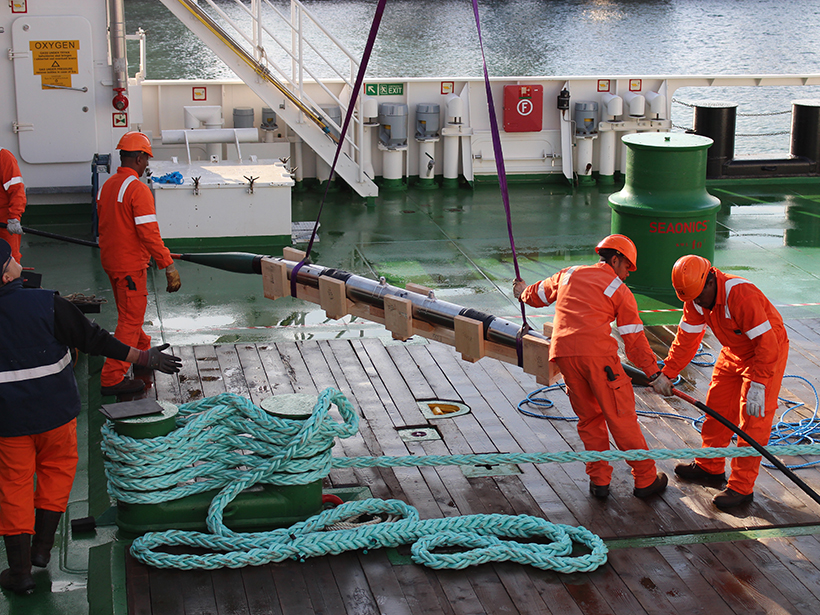
Recovery of one of the Lamont Doherty Earth Observatory instruments aboard R/V Roger Revelle.
Posted inScience Updates

Investigations of Shallow Slow Slip Offshore of New Zealand

by R. Harris, L. Wallace, S. Webb, Y. Ito, K. Mochizuki, H. Ichihara, S. Henrys, A. Tréhu, S. Schwartz, A. Sheehan, D. Saffer and R. Lauer 28 March 201618 January 2022

Recent and upcoming studies of the Hikurangi margin east of New Zealand shed light on previously undetectable tectonic movements.

Posted inNews

Navy Ship Mysteriously Lost in 1921 Found via Science, Sleuthing

by Randy Showstack 25 March 201614 January 2022

Scientists painstakingly compared a shipwreck spotted in 2009 to a 1904 schematic of a long-lost tugboat. A naval gun on the wreck proved to be the "smoking gun" identifying the vanished ship.

Posted inEditors' Vox

What Are Scientists Doing off the Oregon Coast in Winter?

by M. Goni 22 March 201630 August 2022

Social media and the value of communicating field experiences to the public

Posted inResearch Spotlights

Moored Ocean Buoy Tracks Marine Carbon Cycle Variations

by Mark Zastrow 14 March 201617 March 2023

Years of data from a North Pacific ocean station show that the ocean's ability to pull carbon out of the atmosphere is controlled by biological and physical processes that change between seasons.

Posted inResearch Spotlights

How Oceans Could Change If We Reverse Anthropogenic Warming

by David Shultz 4 March 20167 March 2023

A computer simulation shows a net increase in primary production by phytoplankton if climate change were mitigated by 2200 but also indicates big changes in the makeup of those species.

Posted inResearch Spotlights

The North Atlantic Ocean's Missing Heat Is Found in Its Depths

Cody Sullivan by C. Sullivan 3 March 201612 January 2022

In the 2000s, the North Atlantic stopped absorbing as much atmospheric warmth. However, the ocean lost only a little heat—the rest was held deeper below the surface by altered circulation patterns.

Posted inResearch Spotlights

Ocean Waves Vibrating the Ross Ice Shelf

by L. Strelich 26 February 201613 January 2022

Scientists use seismic stations to study ice shelf vibrations generated by ocean waves to better understand their impact on the integrity of the Ross Ice Shelf.

Posted inResearch Spotlights

New Methods Measure How Vertical Land Motion Affects Sea Level

by L. Strelich 23 February 20161 November 2021

Researchers demonstrate the value of combining GPS and satellite data on vertical motion of the Earth's surface with tide gauge measurements to track rising sea levels.

Posts pagination

Newer posts 1 … 103 104 105 106 107 … 113 Older posts
Over a dark blue-green square appear the words Special Report: The State of the Science 1 Year On.

Features from AGU Publications

Research Spotlights

What Australian Lakes Showed Us About Martian Hydrology

27 July 202627 July 2026
Editors' Highlights

Rising CO2 Alters Upper Atmosphere Response to Stratosphere Sudden Warming

29 July 202627 July 2026
Editors' Vox

The Hidden Costs of Mining River Sand

27 July 202627 July 2026
Eos logo at left; AGU logo at right

About Eos
ENGAGE
Awards
Contact

Advertise
Submit
Career Center
Sitemap

© 2026 American Geophysical Union. All rights reserved Powered by Newspack