• About
  • Special Reports
  • Topics
    • Climate
    • Earth Science
    • Oceans
    • Space & Planets
    • Health & Ecosystems
    • Culture & Policy
    • Education & Careers
    • Opinions
  • Projects
    • Postcards From the Field
    • ENGAGE
    • Editors’ Highlights
    • Editors’ Vox
    • Eos en Español
    • Eos 简体中文版
    • Print Archive: 2015–2025
  • Policy Tracker
  • Blogs
    • Research & Developments
    • The Landslide Blog
  • Newsletter
  • Submit to Eos
  • AGU.org
  • Career Center
  • Join AGU
  • Give to AGU
  • About
  • Special Reports
  • Topics
    • Climate
    • Earth Science
    • Oceans
    • Space & Planets
    • Health & Ecosystems
    • Culture & Policy
    • Education & Careers
    • Opinions
  • Projects
    • Postcards From the Field
    • ENGAGE
    • Editors’ Highlights
    • Editors’ Vox
    • Eos en Español
    • Eos 简体中文版
    • Print Archive: 2015–2025
  • Policy Tracker
  • Blogs
    • Research & Developments
    • The Landslide Blog
  • Newsletter
  • Submit to Eos
Skip to content
  • AGU.org
  • Career Center
  • Join AGU
  • Give to AGU
Eos

Eos

Science News by AGU

Support Eos
Sign Up for Newsletter
  • About
  • Special Reports
  • Topics
    • Climate
    • Earth Science
    • Oceans
    • Space & Planets
    • Health & Ecosystems
    • Culture & Policy
    • Education & Careers
    • Opinions
  • Projects
    • Postcards From the Field
    • ENGAGE
    • Editors’ Highlights
    • Editors’ Vox
    • Eos en Español
    • Eos 简体中文版
    • Print Archive: 2015–2025
  • Policy Tracker
  • Blogs
    • Research & Developments
    • The Landslide Blog
  • Newsletter
  • Submit to Eos

transdisciplinary science

An Anopheles gambiae mosquito, the primary mosquito vector responsible for transmitting malaria in most of sub-Saharan Africa, sucks the blood of a human.
Posted inScience Updates

Climate Predictions and Infectious Diseases in Southern Africa

by T. Ikeda, Y. Morioka and C. Y. Wright 5 May 20169 September 2024

Symposium for Science and Technology Research Partnership for Sustainable Development (SATREPS) Project 2015; Pretoria, South Africa, 12 October 2015
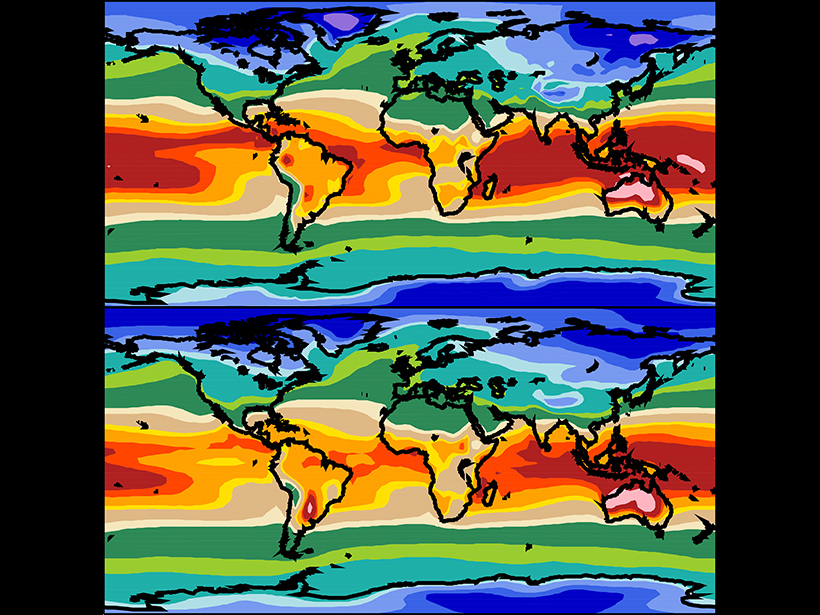
(top) Observed and (bottom) simulated seasonal mean (December–January–February) 2-meter surface air temperature data.
Posted inScience Updates

A More Powerful Reality Test for Climate Models

by P. J. Gleckler, C. Doutriaux, P. J. Durack, K. E. Taylor, Y. Zhang, D. N. Williams, E. Mason and J. Servonnat 3 May 201622 August 2022

A new climate model evaluation package will deliver objective comparisons between models and observations for research and model development and provide a framework for community engagement.

Satellite view of the United States at night.
Posted inScience Updates

Challenges and Opportunities in Earth-Human Systems Research

by G. R. Asrar, R. Moss and K. L. Jacobs 25 April 20167 March 2023

Opportunities for Integration of Remote Sensing, Integrated Assessment, and Adaptation; Aspen, Colorado, 11–16 October 2015

Chalkboard drawing of globe surrounded by symbols of Christianity, Islam, Hinduism, Buddhism, and Judaism.
Posted inOpinions

Faith and Science Working Together on Climate Change

by S. G. Bingham 14 April 201624 November 2025

When science can show that the poorest among us are suffering first and worst from human-induced climate change, religions can motivate people of faith to care and to act.

Posted inOpinions

Diversifying Skills and Promoting Teamwork in Science

by J. M. Jeschke, S. S. Kaushal and K. Tockner 8 April 201627 March 2023

Truly innovative research requires intellectually diverse teams of scientists who are encouraged to excel in the tasks where their talents lie.

Posted inEditors' Vox

Tidal River Dynamics

by Mark Moldwin 6 April 201624 February 2023

Tidal rivers are a vital and little studied nexus between physical oceanography and hydrology.

Posted inScience Updates

Learning About Teaching: Geoscience Educators Share Insights

by C. A. Manduca, R. Heather Macdonald and L. Goodell 1 April 201623 February 2023

Earth Educators' Rendezvous; Boulder, Colorado, 13–17 July 2015

Boat docks near the shores of Lake Travis, near Austin, Texas, during the 2011 drought.
Posted inScience Updates

Anticipating Cascading Effects from Climate Extremes

by S. LeRoy, G. Garfin and M. Black 29 March 20163 June 2022

Preparing for High Consequence, Low Probability Events: Heat, Water & Energy in the Southwest; Tucson, Arizona, 28–29 September 2015

Posted inNews

Navy Ship Mysteriously Lost in 1921 Found via Science, Sleuthing

by Randy Showstack 25 March 201614 January 2022

Scientists painstakingly compared a shipwreck spotted in 2009 to a 1904 schematic of a long-lost tugboat. A naval gun on the wreck proved to be the "smoking gun" identifying the vanished ship.

Posted inScience Updates

Mexico's University Network of Atmospheric Observatories

by O. Peralta, D. Adams, T. Castro, M. Grutter and A. Varela 12 February 20169 May 2023

Increasing cooperation in Mexico benefits climatologists, meteorologists, and science as a whole.

Posts pagination

Newer posts 1 … 17 18 19 20 21 … 23 Older posts
Over a dark blue-green square appear the words Special Report: The State of the Science 1 Year On.

Features from AGU Publications

Research Spotlights

How Internal Waves Transport Energy Thousands of Miles Across the Ocean

26 March 202626 March 2026
Editors' Highlights

What’s Under the Water Matters

27 March 202626 March 2026
Editors' Vox

The Future of Earth’s Future

24 March 202624 March 2026
Eos logo at left; AGU logo at right

About Eos
ENGAGE
Awards
Contact

Advertise
Submit
Career Center
Sitemap

© 2026 American Geophysical Union. All rights reserved Powered by Newspack