

Want updates from a trusted source about how climate change is altering ecosystems? Preference Eos in your searches!

In recent decades, Earth has literally changed color, increasing in greenness since at least the 1980s. This greening is occurring in various ecosystems, from highly populated areas to largely uninhabited regions above the Arctic Circle. Alpine areas are greening, too: Ecosystems in the Alps and the Rocky Mountains have become more verdant as their plant communities change under a warming climate.
A new study, published in Ecosphere, expands scientists’ understanding of this phenomenon in northeastern North America. Using 41 years of satellite data, the study presents a large-scale analysis of how greening is affecting alpine areas there, including in the White Mountains of New Hampshire, the Adirondacks in New York, and the mountains of Quebec’s Gaspé Peninsula.
The findings show widespread greening and could inform conservation efforts for these sensitive ecosystems as the climate changes.
The new study stands out because it “connects satellite observations with a deep knowledge of the landscape and its plant communities,” Arthur Bayle, an ecologist at the Université de Genève who studies greening in the Alps, wrote in an email to Eos. “What makes it interesting is that it covers a region with distinctive climatic conditions and plant communities, which may respond differently from the mountain systems we are more familiar with.” Bayle was not involved in the new research.
Greening Peaks
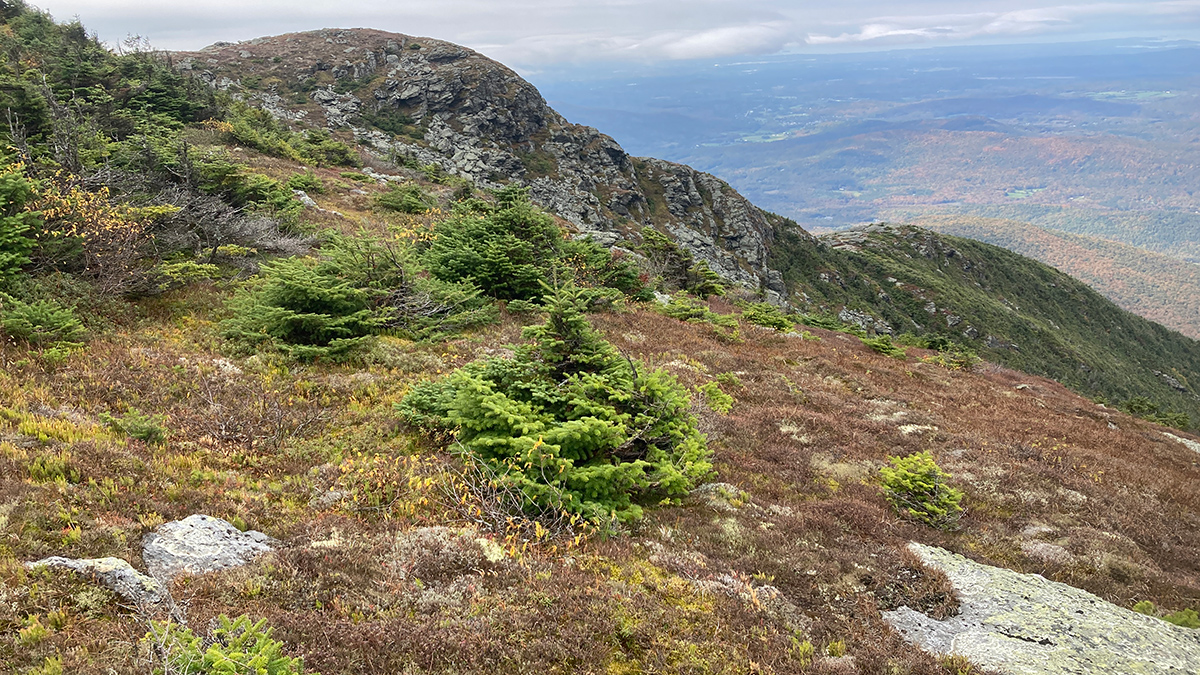
The composition of plant ecosystems is likely changing, shifting from smaller alpine plants with less leaf area to greener, shrubbier species.
For more than 2 centuries, scientists have been cataloging the species present on alpine peaks in these regions, but before now there had been “no systematic, broad-scale geographic lens applied to the whole area,” said Jonathan Chipman, a geographer at Dartmouth College and lead author of the new study. “We realized that satellite remote sensing would provide a way to contextualize all those field studies.”
Researchers used nearly 1,000 satellite images from the Landsat mission from 1984 to 2024 for the analysis. Using the normalized difference vegetation index, they converted the colors present in these images into a greenness value.
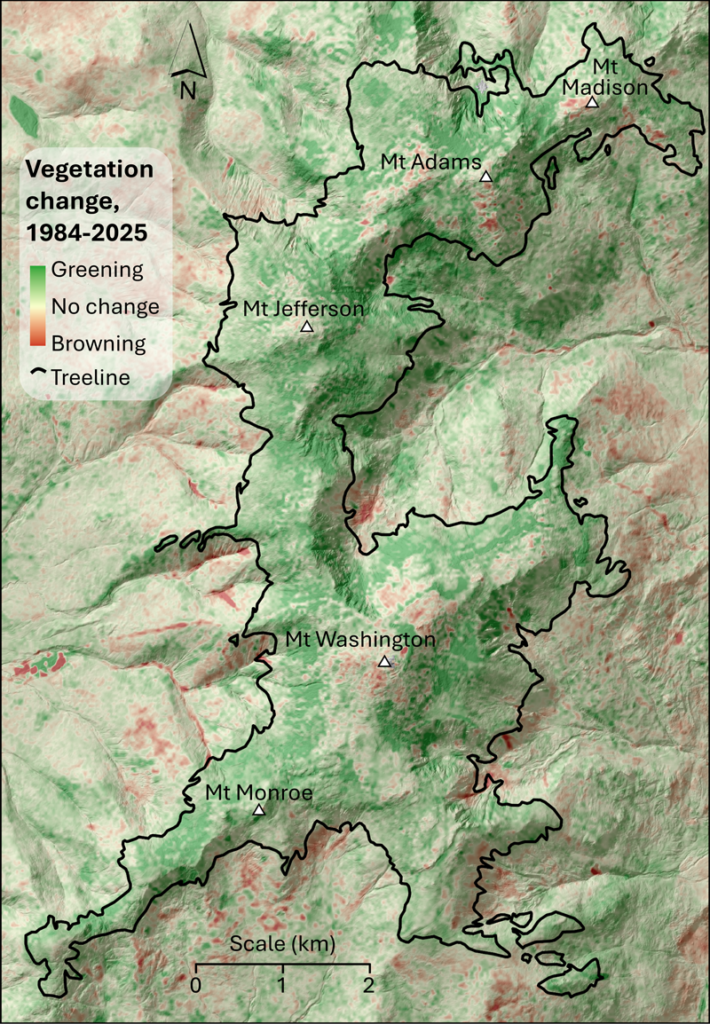
They found that 88% of the alpine area in these regions—about 11,352 hectares—was experiencing significant greening, and none of the sites were getting browner.
Chipman emphasized that the study was a remote sensing study and didn’t draw conclusions about which plant species were present on these peaks. Still, the results mean that in 88% of alpine area in northeastern North America, the composition of plant ecosystems is likely changing, shifting from smaller alpine plants with less leaf area to greener, shrubbier species.
This phenomenon happens in various ways. For example, sensitive alpine plants adapted to cooler weather may slowly die out, while lower-elevation plants adapted to warmer weather move up in elevation and expand their ranges. Another possibility is that certain alpine plants are more resilient to warming weather and outcompete their less resilient neighbors. Invasive species carried by hikers may also contribute to greening.
Greening may also be the result of fertilization from atmospheric nitrogen released by industry, Chipman added. In the late 20th century, before the United States enacted regulations associated with the Clean Air Act, power plants upwind of the researchers’ study sites released large amounts of nitrogen, which may have boosted the growth of plants on downwind peaks. Though these emissions have been greatly reduced, their effects may still persist in alpine ecosystems. “This is a fascinating question to explore,” Bayle wrote. “How have these changes affected alpine vegetation, and how might their effects vary with wind exposure, elevation, and latitude?”
Bayle was surprised that greening was particularly pronounced well above the tree line, suggesting that greening involved a variety of vegetation and was not simply a result of the upward expansion of trees. The results are “another reminder that alpine grasslands are also changing at an accelerated pace,” he wrote, as well as a reminder that “similar greening patterns do not necessarily mean the same ecological processes are at work.”
Winds of (Un)change
Though the researchers found significant alpine greening, many of the region’s peaks did not experience the phenomenon evenly.
“In other alpine zones where things are controlled more directly by temperature, you might expect as the climate warms that that would then allow things to start greening at higher elevations. In the Northeast, it’s more complicated than that.”
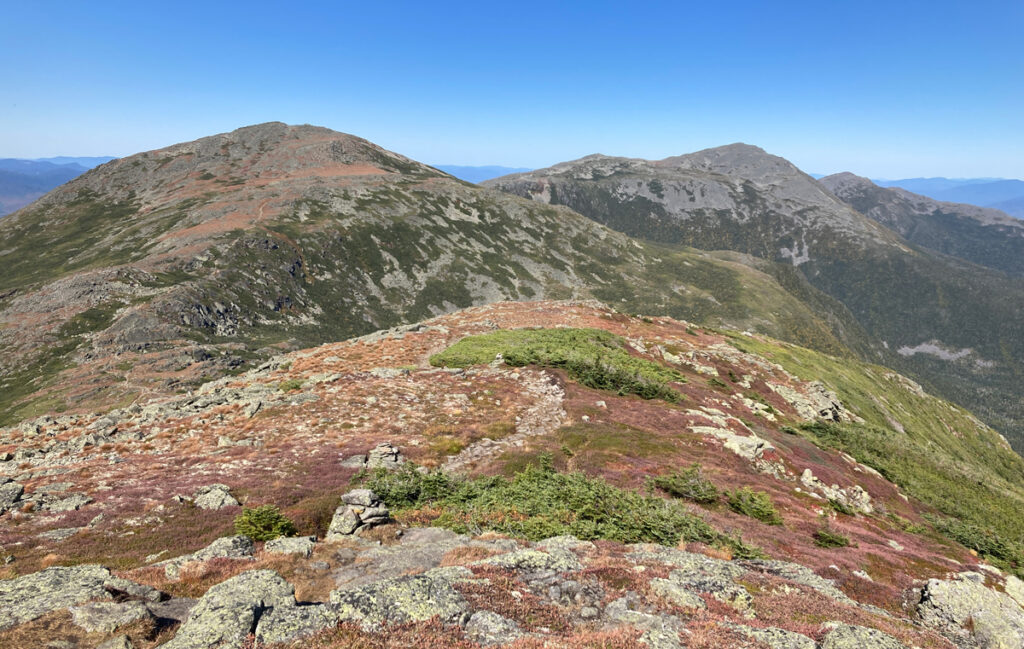
One big reason for this could be the Northeast’s propensity for strong winds: New Hampshire’s Mount Washington, for example, holds the land record for the highest wind speed ever directly observed, at 231 miles per hour (372 kilometers per hour). “All the mountains here are subject to very high winds quite frequently,” Chipman said.
Those high winds keep alpine areas cooler, making them less susceptible to greening. And, high winds in winter can carry ice particles, too, leaving alpine plants essentially “sandblasted,” Chipman said. “In other alpine zones where things are controlled more directly by temperature, you might expect as the climate warms that that would then allow things to start greening at higher elevations. In the Northeast, it’s more complicated than that.”
The hypothesis that strong winds can limit greening “deserves further investigation,” Bayle wrote.
Alpine Protection
Land managers could use the study’s information about where greening is happening the fastest to identify the best sites for conservation efforts. Places where greening rates are slower, and environmental changes have not progressed as much, may be places where there are still sensitive or rare alpine plants to protect.
“If you have, for example, highly wind-exposed areas that are less subject to this greening process, maybe those are areas where you want to avoid putting in new infrastructure or constructing new trails, because those might become really important reservoirs of alpine biodiversity in the future,” Chipman said.
The research group plans to continue to study places where alpine greening is progressing more slowly to try to understand the drivers behind the difference in pace. Chipman emphasized that field studies of the plant community are necessary to understand the whole picture of alpine greening, as well. The new remote sensing study “is a way of complementing field science, not replacing it,” he said.
—Grace van Deelen (@gvd.bsky.social), Staff Writer
This news article is included in our ENGAGE resource for educators seeking science news for their classroom lessons. Browse all ENGAGE articles, and share with your fellow educators how you integrated the article into an activity in the comments section below.