

Extreme wildfire events are becoming more frequent globally, a pattern that carries a risk for human health. Inhaling smoke from fires can send small bits of particulate matter into airways, aggravating asthma and decreasing lung function. But another, far less understood danger is hitching a smokey ride alongside these aerosols: fungi.
Researchers are increasingly recognizing how wildfire smoke can scatter microorganisms like fungi into the air. This phenomenon is part of a budding field called pyroaerobiology, explained Leda Kobziar, a wildland fire scientist at the University of Idaho in Moscow who has been studying the relationship between airborne spores and wildfire smoke since 2018.
New research from Kobziar’s team has confirmed that smoke-borne fungal spores can cause lung disease in mice. Her team took smoke samples from wildfires, isolated the fungal species within them, and exposed mice to these samples. Many of the mice soon showed symptoms of lung disease. The team will present its findings on 16 December at AGU’s Annual Meeting 2025 in New Orleans.
Catching Fire
“It was really an unknown that there were living microorganisms in wildland fire smoke. I think most people assumed that it was sterile because it comes from a hot fire.”
Studying the living side of smoke is a relatively new practice. “It was really an unknown that there were living microorganisms in wildland fire smoke. I think most people assumed that it was sterile because it comes from a hot fire,” said Phinehas Lampman, a former wildland firefighter, coauthor on the study, and wildland fire scientist at the University of Idaho.
The first study exploring the problem was published in 2004 by then–high school student Sarah Mims and her father, who used a smoke detector attached to a kite to collect fungal samples and correlate them with smokey days.
While there are more pyroaerobiologists today than there were 20 years ago, there are still many unanswered questions about what, how, and to what effect fungal spores travel with smoke.
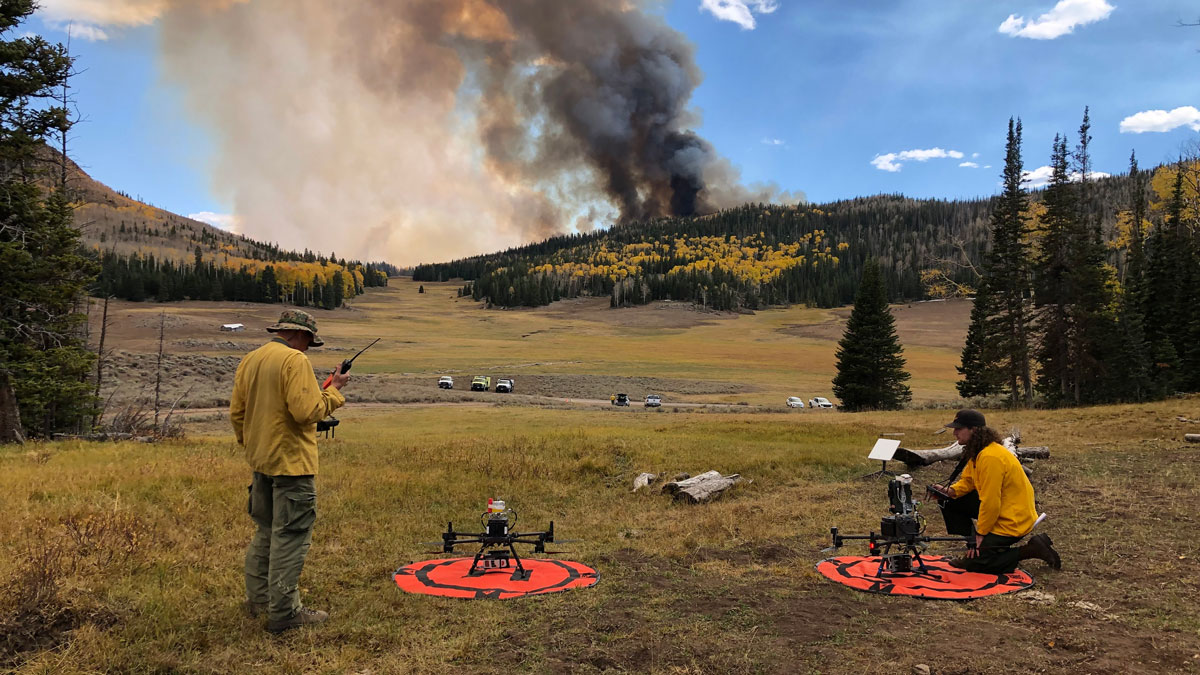
For the new study, Kobziar, Lampman, and their team developed drone-based sampling systems to collect fungal samples and record conditions like temperature and humidity in wildfire smoke. Over a period of 4 years, the team conducted more than 100 drone flights into grassland and conifer forest fires across nine different areas, including sites in Utah, California, Kansas, and Florida.
A majority of the sampling was done at prescribed burns intentionally set by firefighters to reduce wildfire hazard. The controlled nature of prescribed burns allowed the researchers to get up close to fires and better maneuver their drones for sampling.
The team found that wildfire smoke from the prescribed burns contained spore concentrations of up to 400,000 spores per cubic meter, 4 times higher than the threshold that has been shown to decrease lung function.
To find out whether the fungal species present in smoke pose a health risk, the team used spores from the smoke samples to grow and isolate fungal colonies. They found 110 unique fungal taxa, 9 of which were identified to be potential human pathogens.
The researchers then exposed mice to these isolated samples. Over the course of a few weeks, the animals developed symptoms of lung disease in response to three different fungal taxa, suggesting that some fungi in wildfire smoke have the potential to negatively affect human health as well.
Exploring Health Impacts of Fungi in Smoke
Prescribed burns typically burn the same biomass as wildfires, so the composition of fungi in the smoke is likely similar. “But wildfires have a very different size footprint and typically generate a lot more power,” Kobziar said, explaining that large natural fires have the potential to generate much more advection of air and carry more diverse microbes.
Clouds of wildfire smoke with large distributions can act as vectors and scatter potentially dangerous fungi into new areas, said coauthor Borna Mehrad, a pulmonologist at the University of Florida in Gainesville.
“As fires become more frequent, this will become a progressively bigger issue. It’s something that we as physicians hadn’t even considered.”
“As fires become more frequent, this will become a progressively bigger issue,” he said. “It’s something that we as physicians hadn’t even considered.”
Despite the concerning finding, it’s important to note that not all fungi dispersed by wildfire smoke are a concern for human health, said Jennifer Head, an epidemiologist at the University of Michigan in Ann Arbor who was not involved in the new research. “The species of fungus matters a lot in terms of what is the risk posed to human health.” She stressed the need for future research to characterize which fires, and where, are most concerning as vectors for dangerous fungi.
Looking forward, the team seeks to differentiate the various causes of lung disease and uncover what proportion of negative health effects are caused by smoke-borne fungi. The team hopes their findings could help protect people on the frontlines of major burns, like wildland firefighters.
“This is really just the opening of the box of discovery,” Kobziar said.
—Alonso Daboub (@AlonsoDaboub), Science Writer