
Albert Einstein postulated in his 1905 theory of special relativity that the speed of light in a vacuum is constant. Ever since, that’s been one of the fundamental assumptions of physics.
Now Enbang Li, a physicist at the University of Wollongong in Australia, has challenged this idea by building a machine he says is capable of detecting changes in the speed of light as it crosses Earth’s surface. The findings suggest that light is, in fact, sped up by gravity, which could have implications for Earth science applications ranging from climate monitoring to mineral resource exploration.
An Old Conundrum
The idea that light is influenced by gravity is not new. Einstein’s ideas, which were further developed with his theory of general relativity in 1915, predicted massive objects in space would bend light with their gravitational grab. This theory was famously proven in 1919 when two independent teams measured starlight passing a solar eclipse at two different points on Earth’s surface and found the results matched Einstein’s predictions.
This bending of light’s path, according to general relativity, is achieved by a warping of the space-time fabric. Under this scenario, the speed of light remains constant—it just has to travel farther as it navigates the warped space-time around celestial bodies, so to a distant observer, it appears to have been slowed.
But what if light doesn’t navigate warped space-time and actually is slowed down or sped up by the gravity of large objects?
Li pointed out that Einstein himself was not always convinced the speed of light was constant. In 1911, he wrote a paper postulating that light speed changed depending on the gravity of objects it passed by. However, “when he published his general theory,” said Li, “he just abandoned this model.”
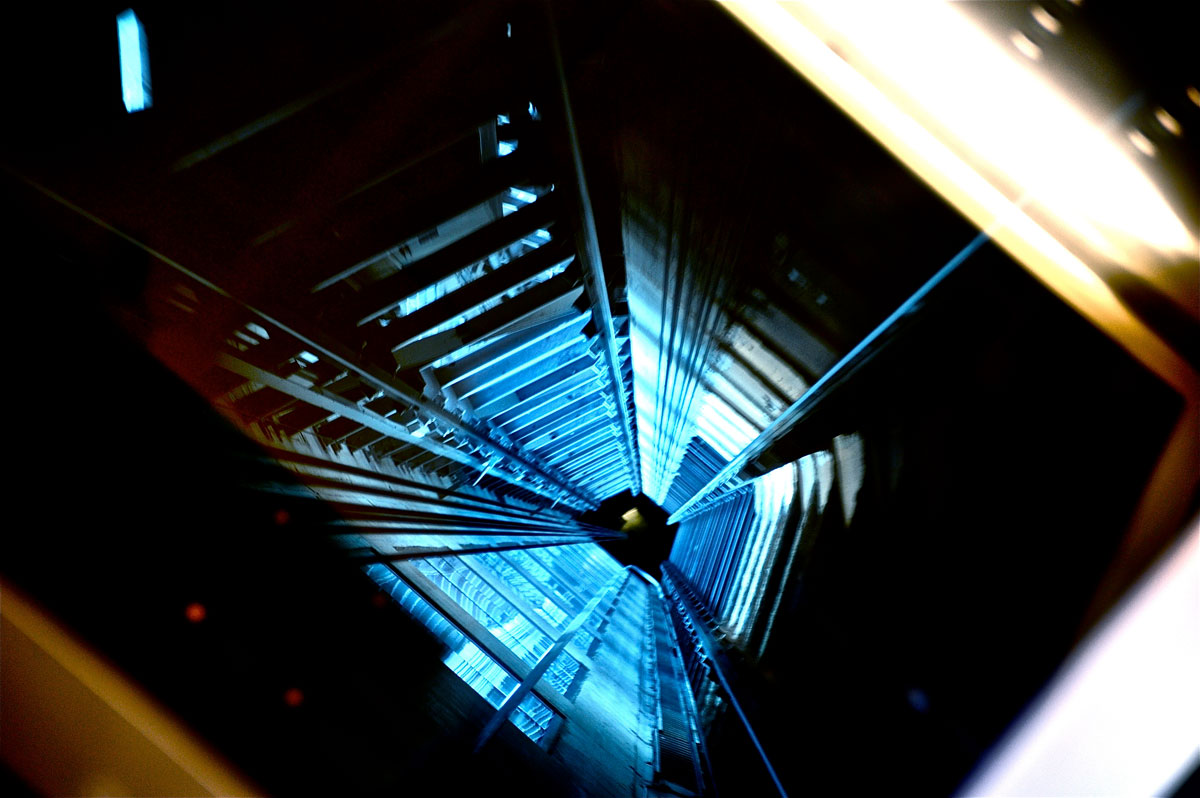
If the movement of light can be affected by gravity, Li reasoned, it might be possible to detect variations in its speed on a local level—such as an elevator shaft in a building on the campus of the University of Wollongong.
Raising the Big Issues
Gravity on Earth varies locally, depending on altitude, underground density, and topography. Gravity at the top of a tall building, for example, is measurably weaker than it is at the bottom.
With these variations in mind, Li installed an experiment in an elevator. It consisted of a coil of fiber-optic cable that if stretched out in one direction, would be 10 kilometers (6.2 miles) long. Laser beams were fired through the cables and then reflected back, thus traveling 20 kilometers (12.4 miles) before reaching an ultrafast photodetector. An oscilloscope measured the time it took for the beam to travel that distance. The experiment was run at the top of the shaft and at the bottom.
The biggest challenge, Li said, was filtering out all the surrounding environmental “noise,” such as changing temperature and humidity, electromagnetic disturbance, and building vibrations. Li designed a temperature control system, and the experiment was sealed in an enclosure with electromagnetic shielding to isolate air flows. Li ran the experiment and found light moved minutely faster at the bottom of the shaft than at the top.
Gravity Sensing on the Go
Next, Li took his research a step further by building a small, portable machine he claims can detect changes in the speed of light as it nears more gravitationally dense objects.
In this second experiment, Li positioned a moveable 72-kilogram (159-pound) weight near the machine. Light, he found, moved faster when the weight was near the machine than when it was farther away.
The results, which were published in Scientific Reports, are consistent with the variable speed of light model Einstein proposed in 1911, although Li’s preliminary results are much larger than that model predicts.
If proven, the findings would present a fundamental challenge to our understanding of both general and special relativity.
In the world of Earth sciences, they could lead to greatly improved gravity-sensing technologies. Because of their sensitivity to changes in mass, gravity sensors are used to map the seafloor and to locate underground mineral reserves. Gravity sensing can also improve our understanding of Earth’s climate as variations in the gravity field can be linked to factors like changes in ice mass and shifts in groundwater.
Currently, gravimeters are vulnerable to vibrations and movement, whereas Li’s machine, which has no moving parts, could even be used on board a plane or submarine.
“A Striking Claim”
Chris Stevens, a numerical relativist with the University of Canterbury in New Zealand, called the work “intriguing and ambitious.” While Stevens, who was not involved in the research, said that Li’s work is “well founded,” he noted that any observable effects of gravity on light on Earth would be “extraordinarily small” and therefore these results must be treated with caution.
“In my own research on observable gravitational phenomena,” he explained, “I usually require a few black holes colliding somewhere in the universe. Separating genuine gravitational signatures from environmental and instrumental noise will therefore be exceptionally demanding.”
“The work is exciting because it pushes precision photonic measurement techniques into a regime where relativistic effects may become practically useful for geophysics and sensing applications.”
Stevens said the implications of Li’s research, if validated, would be far-reaching. “The work is exciting because it pushes precision photonic measurement techniques into a regime where relativistic effects may become practically useful for geophysics and sensing applications.”
John Norton, an historian of physics at the University of Pittsburgh who was also not involved in the research, called the findings a “striking claim.” He was, however, skeptical of them, saying “if there is a coupling between light and gravity of magnitude greater than general relativity predicts, it is hard to see how the 1919 eclipse test and later studies of gravitational lensing would not have found it.”
Li acknowledged there is a long way to go before his device finds everyday use. Disentangling the intricacies of space and time, he said, is a vast challenge. “In physics, people still say gravity is a mystery. Light is another mystery. So if you put these two mysteries together, that’s going to be a giant mystery.”
—Bill Morris, Science Writer