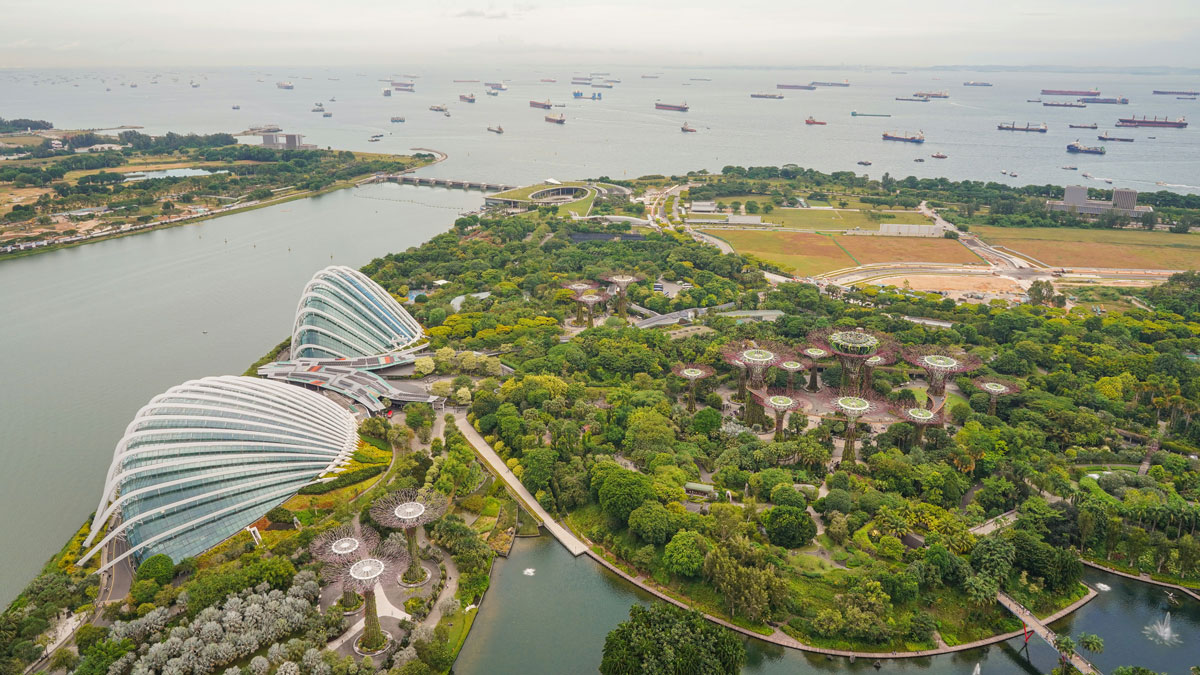
Source: Water Resources Research
Fringed with swamps and mangroves, a swath of tropical lowland forests once covered what is now the densely populated island country of Singapore. Today, buildings, pavements, and other structures have replaced more than 60% of the original land cover. Still, urban greening efforts have kept Singapore one of the greenest cities in the world.
With limited natural water resources, Singapore has made sustainable water management a top priority. Its reliance on imported water was sharply reduced through an extensive rainwater collection network of canals, drains, and 17 reservoirs, which collectively cover about two thirds of Singapore’s land area.
However, climate change and urbanization dramatically affect hydrological processes in Singapore and other tropical urban settings around the world, posing ongoing water management challenges. New simulations by Lin Xu et al. provide the first fine-resolution picture of how natural and urban hydrologies interact to affect Singapore’s long-term, island-wide water budget.
The researchers employed an ecohydrological model specifically adapted for urban environments. Unlike models often adopted in prior studies, which mostly focused on how short-term rainfall affects local-scale flood risk, this model accounts for the nuanced interplay between the properties of urban vegetation, a changing climate, and the built environment—at an hourly timescale and a spatial resolution of 250 meters. The model can also simulate multidecadal scenarios.
First, the research team evaluated how past deforestation and urbanization have changed Singapore’s energy balance today. They found milder shifts than expected, primarily attributable to reduced transpiration, the process in which leaves release water vapor into the air. As impermeable surfaces (such as roads and pavements) increased to 35%, water runoff levels increased by 16.5%. Sensible and latent heat fluxes—measurements relevant to surface energy budget and water cycling—increased by about 4.6% and decreased by 11%, respectively.
Next, the researchers evaluated how future climate change and urbanization might affect Singapore’s hydrology. Their analysis suggests that a continued decrease in transpiration by urban plants will compensate for increased evaporation and a “thirstier” atmosphere, meaning that variations in rainfall will be the main factor influencing the future of Singapore’s water budget. However, simulations of extremely dry years, such as during El Niño conditions, highlight the possibility of severe water shortages in rainwater harvesting, which is one of the four “national water taps.”
This study could help inform future water management planning and policy in Singapore. Similar approaches could be applied to other cities around the world, including other tropical cities and cities that rely on local water resources, such as Los Angeles and Jakarta, the authors suggest. (Water Resources Research, https://doi.org/10.1029/2025WR041411, 2026)
—Sarah Stanley, Science Writer