
Scientists of all stripes know the value of collecting and using data to answer research questions about everything from microscopic life to Earth system processes to space physics. But what about the value of data shedding light on peers within their own research communities?
Such data can help scientists better understand the makeup of their field and help them find and connect with colleagues. Compiled into an up-to-date, worldwide directory of researchers in a given discipline, for example, they could help people search for employment opportunities, identify possible collaborators, and suggest potential reviewers for papers and proposals.
These data can also help scientists who are early in their careers or otherwise less visible within their community to gain recognition. And they can be used to identify emerging research areas and trends indicating fields that are thriving or declining—important information not only for scientists themselves but also for funding bodies, oversight committees, and policymakers.
Researchers may have ideas of the approximate size and composition of their community, but hard numbers and comprehensive information are difficult to come by.
Researchers may have ideas of the approximate size and composition of their community based on conferences they attend and journal articles they read, but hard numbers and comprehensive information are difficult to come by. Demographic surveys conducted by professional societies or funding agencies typically provide incomplete information, because not everybody responds to them, they may cover single countries only, and they’re performed infrequently.
The need for workforce demographic data was highlighted in the recent National Academies’ Decadal Survey for Solar and Space Physics, which specifically called (in recommendation 4-1) for U.S. federal agencies to fund collection of this information to help determine the state of the profession.
An underused resource for this data collection is hiding in plain sight: the body of scientific articles produced by the research community. By combining the metadata from these articles with Open Researcher and Contributor IDs (ORCIDs) that uniquely identify authors, it is possible to extract accurate, current information about researchers and their work.
HelioIndex is a new, automated online directory that uses this approach to offer an evolving snapshot of the global community in the field of solar and heliospheric physics (SHP) [Young, 2025]. HelioIndex’s methods are generalizable and can be applied as long as researcher ORCIDs are widely used in research publications, meaning it offers a model for developing similar tools in many other scientific fields.
The Who, What, Where, and How Much of SHP
SHP includes science focused on all aspects of the Sun, from its interior through its atmosphere, out into the solar wind, and all the way to the outer edge of the heliosphere. HelioIndex currently identifies more than 2,300 active SHP researchers in about 60 countries, offering information about these scientists’ geographic distribution, institutional affiliations, areas of expertise (derived from journal article keywords), and publication records.
Figure 1 offers a glimpse of how HelioIndex can be used to consider geographic trends, for example, showing the 10 countries with the most researchers included in the directory. As of July, the United States had the largest share at 29.1%, followed by China and the United Kingdom.
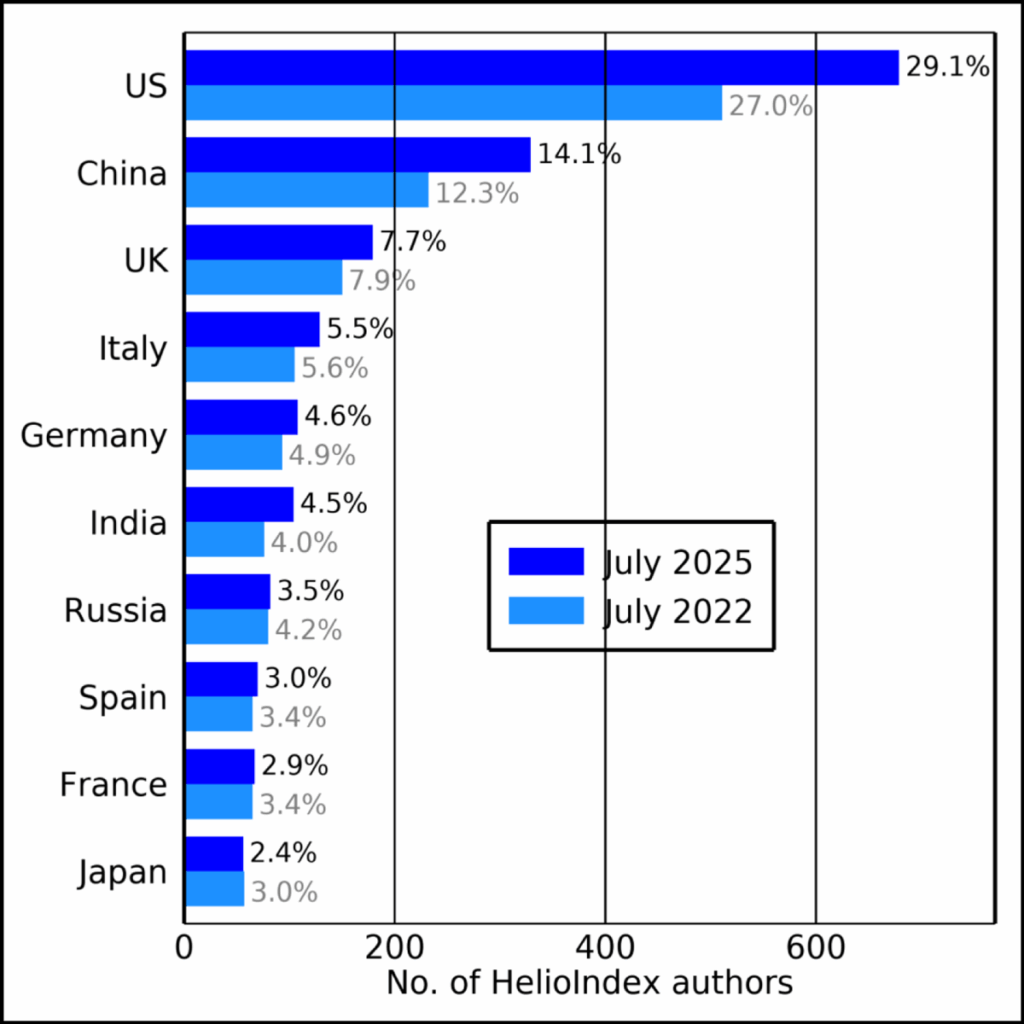
Updated twice a month using freely available publication data, HelioIndex always provides the most recent data, but figures from earlier dates can be used to track changes over time. Figure 1 also compares the current numbers of researchers in HelioIndex in the top 10 countries with the corresponding numbers from 3 years earlier and shows how each country’s proportional share of the SHP community has changed during that time.
From July 2022 to July 2025, China, India, and the United States, for example, saw standout increases of 42%, 39%, and 33%, respectively, in their numbers of SHP researchers. The increases contributed to these countries’ growing shares of the global total population of SHP scientists during this 3-year period. Meanwhile, growth in several European countries in the top 10 has been smaller, leading to generally decreased shares of the overall community population.
These numbers demonstrate that overall, SHP as a field is growing. The extent of growth shown in different countries may help early-career scientists to decide where to pursue their careers. The data may also be valuable to national funding bodies for assessing their countries’ competitiveness and determining whether funding levels are appropriate.
An important function of HelioIndex is to enhance the visibility of researchers and their work, especially researchers who have few opportunities for recognition.
At the other end of the scale from the top 10 countries, almost half of the countries are represented in HelioIndex with five or fewer SHP researchers. An important function of HelioIndex is to enhance the visibility of researchers and their work, especially researchers in countries with smaller SHP research communities or who have few opportunities for recognition. Greater visibility can foster new collaborations and research directions and help researchers to prosper and develop research communities in their countries.
The publication and ORCID data used in HelioIndex also enable users to better understand publishing trends within the SHP community. For example, these data allow calculation of the average annual number of first-authored, refereed (FAR) articles per person across all HelioIndex authors.
Knowing this average—currently 0.68, which equates to about two FAR papers every 3 years—is valuable for managing expectations in the field. It may reassure young researchers feeling pressure to publish frequently to advance in their careers that success does not necessarily require such a rapid publishing pace. Meanwhile, if a researcher submits a grant proposal claiming their project will yield 10 FAR papers in a 3-year period, the HelioIndex data suggest that a reviewer considering the proposal would have a right to be skeptical!
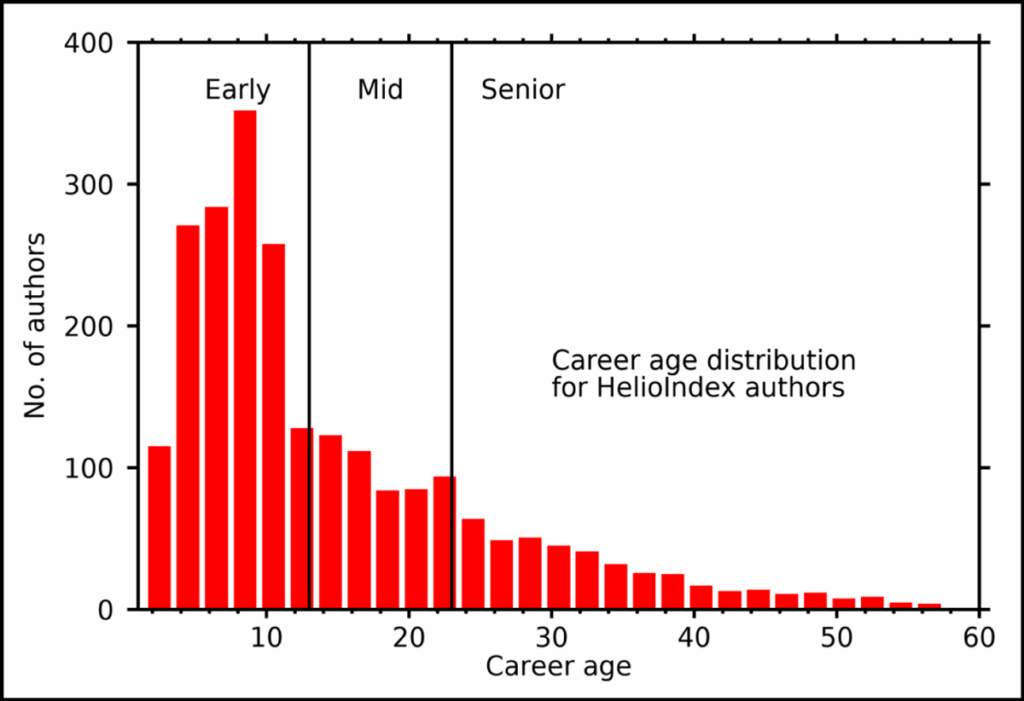
A “career age” can also be estimated for each HelioIndex author, using the publication date of their first FAR paper as age 0. This leads to a plot of age distributions (Figure 2), with vertical lines indicating boundaries between early-, middle-, and senior-career categories. The current median career age of all authors in HelioIndex is 9.9 years.
The age distribution and calculated career ages seemingly skew toward younger ages, likely because ORCIDs came into use only in 2009. Whereas most articles published since then will be linked to authors’ ORCIDs and thus included in the HelioIndex data, older articles may be missing for some researchers. However, it is clear from the long tail of the distribution that many senior authors have manually updated their ORCID records.
A Community-Specific Resource
HelioIndex differs from other resources that contribute to professional networking in that it serves a particular research community.
HelioIndex differs from other resources that contribute to professional networking such as ORCID, Scopus, and LinkedIn in that it serves a particular research community.
The procedure for populating HelioIndex begins with scheduled, automatic queries of recent scholarly literature—as captured in NASA’s Astrophysics Data System (ADS) bibliographic database—for articles related to SHP. Articles are likely to be flagged if they, for example, reference prominent review papers, mention a major SHP observatory or spacecraft, or include certain keywords (e.g., “solar flare”).
For each article found by the queries, the names and ORCID identifiers of the authors are gathered and added to a master list of potential HelioIndex authors. As journals generally do not have standard formats for specifying author affiliations, HelioIndex uses custom software to extract institution names and countries from affiliation information through string matching. (Affiliations listed in HelioIndex are updated routinely based upon an author’s most recent publication.)
Authors are included in HelioIndex based on meeting specific keyword criteria and publication criteria. Most journals require authors to assign several keywords to their articles to indicate the area of research to which their work belongs. For inclusion in HelioIndex, it is required that at least 15% of an author’s keywords across all their published articles contain “solar,” “Sun,” or “interplanetary.” This approach has proven effective in distinguishing SHP scientists from scientists in neighboring fields such as stellar physics and magnetospheric physics.
The publication criteria include having at least one refereed article published within the past 3 years, at least one FAR paper in their career, a career age of at least 2, and at least six total points (authorship of a FAR paper counts as two points and coauthorship of a paper counts as one point). These criteria have been chosen so that HelioIndex, at least initially, primarily represents the community of SHP researchers who have earned a doctoral degree and are part of the professional workforce.
Of course, it is difficult to ensure that the directory includes everyone it should in the SHP community. Using the criteria above, for example, it is possible that some early-career researchers—who perhaps haven’t published enough research yet—may be unintentionally excluded. Such issues can be overcome, however, because as the directory’s creator (and part of the SHP community myself), I can readily assess its completeness and adjust query parameters as needed, and I can directly respond to questions about or requests to be added to HelioIndex.
Listed authors can also check their own data, identify omissions or errors, and request not to be listed by name (though in such cases, their geographic and publication data still count toward the general statistics, such as shown in Figures 1 and 2, to maintain completeness).
Scientists Finding Scientists
In addition to providing basic demographic data about the current community of SHP scientists, HelioIndex can serve many other functions. Students and other researchers exploring career options can quickly assess where scientists in the SHP community are concentrated (or not) and use the keyword data to determine with whom their expertise and interests match. They can also browse publication lists to determine scientists’ interests, activity levels, and collaborators.
HelioIndex can also be used to identify potential reviewers for a submitted journal article by matching authors’ keywords to those used in the article. This usage allows an author (or journal editor) to suggest reviewers they may otherwise not have considered, helping diversify the reviewer pool and raise the visibility of peers. This use of HelioIndex may also benefit program managers at funding agencies looking for scientists to sit on review panels.
In just the few months since HelioIndex was publicly announced, traffic to it has been robust and feedback from users has been largely positive. In September and October, for example, the site received a combined 14,651 unique visitors—higher-than-expected traffic considering the modest size of the SHP community. Individuals have commented, for example, that HelioIndex has revealed researchers and research they weren’t previously aware of, and that it helps scientists “grasp the global view of the community of Solar Physics and Heliophysics in the world,” in the words of one midcareer scientist. These early indications suggest that HelioIndex is providing valuable services to many in this community, and seemingly even to many outside it.
The basic mechanics and principles of HelioIndex can be readily applied to develop similar resources for other scientific fields, no matter their size or scope.
Beyond SHP, the basic mechanics and principles of HelioIndex can be readily applied to develop similar resources for other scientific fields, no matter their size or scope, although specific aspects of the literature queries and keyword criteria would need to be adjusted. The initial article search, for example, would need to be modified to cover relevant journals and keywords. The keyword search would need updating too; to distinguish volcanologists from geoscientists in neighboring fields, say, the keyword search could require “volcano.” (Requiring “Earth” as well could help exclude those who study volcanoes elsewhere, such as on Mars or Io.) Author publication criteria could also be revised if, for example, average publishing trends in other fields differ from those in SHP.
As the ADS database is not currently complete for the Earth sciences or other fields outside of astrophysics, an alternative source for publication data, such as Web of Science or Scopus, may be needed. Furthermore, the approach of designing custom software to pull affiliation information from articles into HelioIndex, which worked well for the relatively small SHP research community, may be more challenging for larger fields with many more institutions represented.
HelioIndex demonstrates that scientific article metadata are a rich resource that can be efficiently and effectively mined to complement the sporadic data collected through researcher surveys. With a baseline of consistent and reproducible demographic data, geographic, temporal, and subject matter trends can be identified, providing a variety of valuable information about and for research communities.
References
Young, P. R. (2025), HelioIndex: A directory of active researchers in solar and heliospheric physics, Sol. Phys., 300, 77, https://doi.org/10.1007/s11207-025-02488-y.
Author Information
Peter Young ([email protected]), NASA Goddard Space Flight Center, Greenbelt, Md.