
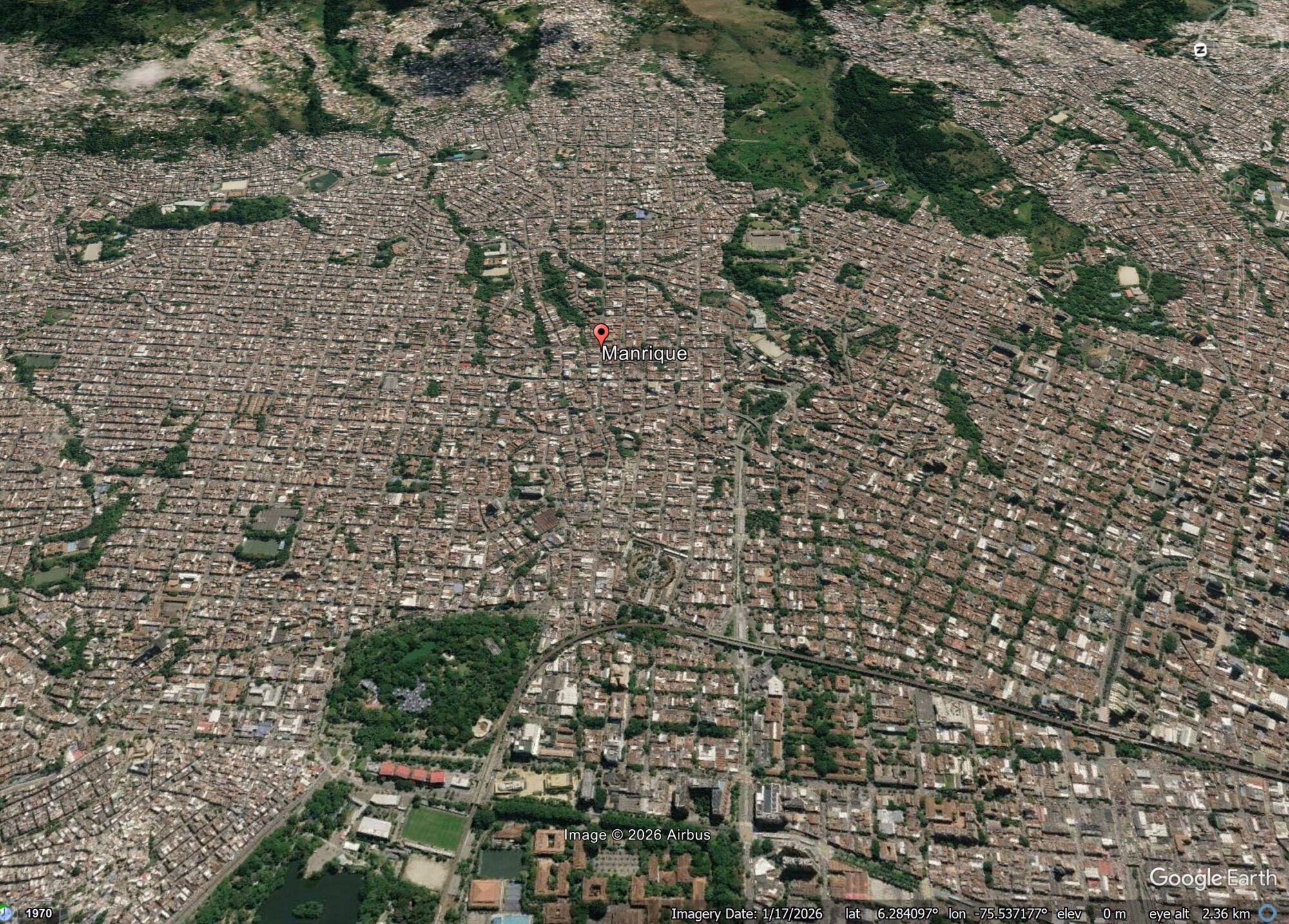
A new study (Vega et al. 2026) shows that patterns of reported structural damage in Medellin are probably caused by deep-seated deformation driven by a series of ancient landslides under the city.

Medellin is the second largest metropolitan area in Colombia, with a population of around 4 million people. It has grown rapidly, expanding into the surrounding hillsides, with many unplanned and informal communities on steep slopes. Landslides are a common problem.
The rapid rate of growth has been accompanied with many reports of structural failures in buildings, with a general (and not unreasonable) assumption that these are associated with poor construction quality. But a fascinating new study (Vega et al. 2026) in the journal Landslides challenges this assumption in a most interesting way. The headline from the study is that there is a strong correlation between areas that have a high density of reports of structural damage and ground deformation driven by large, deep-seated landslides.
Vega et al. (2026) have used InSAR to map ongoing displacements across Medellin. In three key areas (Doce de Octubre, Manrique and Villa Hermosa) they detected high rates of ground deformation. They were able to show that these areas correspond to mappable deep-seated landslides. An example is in the Manrique neighbourhood of Medellin:-
Interpretation of pre-urbanisation imagery suggests that the topography underlying Manrique includes a series of deep-seated landslides. The InSAR data indicate that these areas are actively deforming, and these deformation zones correspond to areas with a high density of reports of structural damage. Interestingly, the density of damage reports does not correlate with the style of construction of the buildings.
Vega et al. (2026) also note that many of the recent acute landslide events in recent years also lie within these areas of high underlying ground deformation. Fore example, the 24 June 2025 landslide that killed 27 people lies within an area highlighted by the InSAR analysis.
This study highlights two key things for me. First, it is a novel and interesting application of InSAR in an urban setting, allowing the underlying processes that are driving structural damage in the city to be understood. Second, the study highlights the underlying vulnerability of Medellin to deep-seated slope processes. As the climate continues to change, and human processes modify the landscape and the groundwater, management of these slopes would seem to be a high priority.
Reference
Vega, J., Aristizábal, E., Ospina, A. et al. 2026. Neighbourhoods in motion: unveiling the drivers behind structural damage hotspots in Medellín (Colombia). Landslides (2026). https://doi.org/10.1007/s10346-026-02758-1