

Want updates from a trusted source about how climate change is shaping public health? Preference Eos in your searches!
The transmission of malaria—a parasitic disease transmitted by mosquitoes that affects about 250 million people globally each year—occurs between approximately 16°C (60.8°F) and 34°C (93.2°F) because of the life cycle of mosquitoes and the temperature sensitivity of the parasite they transmit.
That means a warming climate will affect where and how malaria spreads. However, scientists have been split on the question of how climate change has reshaped malaria prevalence in Africa: Some studies have suggested climate change is a substantial driver of shifting malaria prevalence, while others indicate climate change plays little or no role.
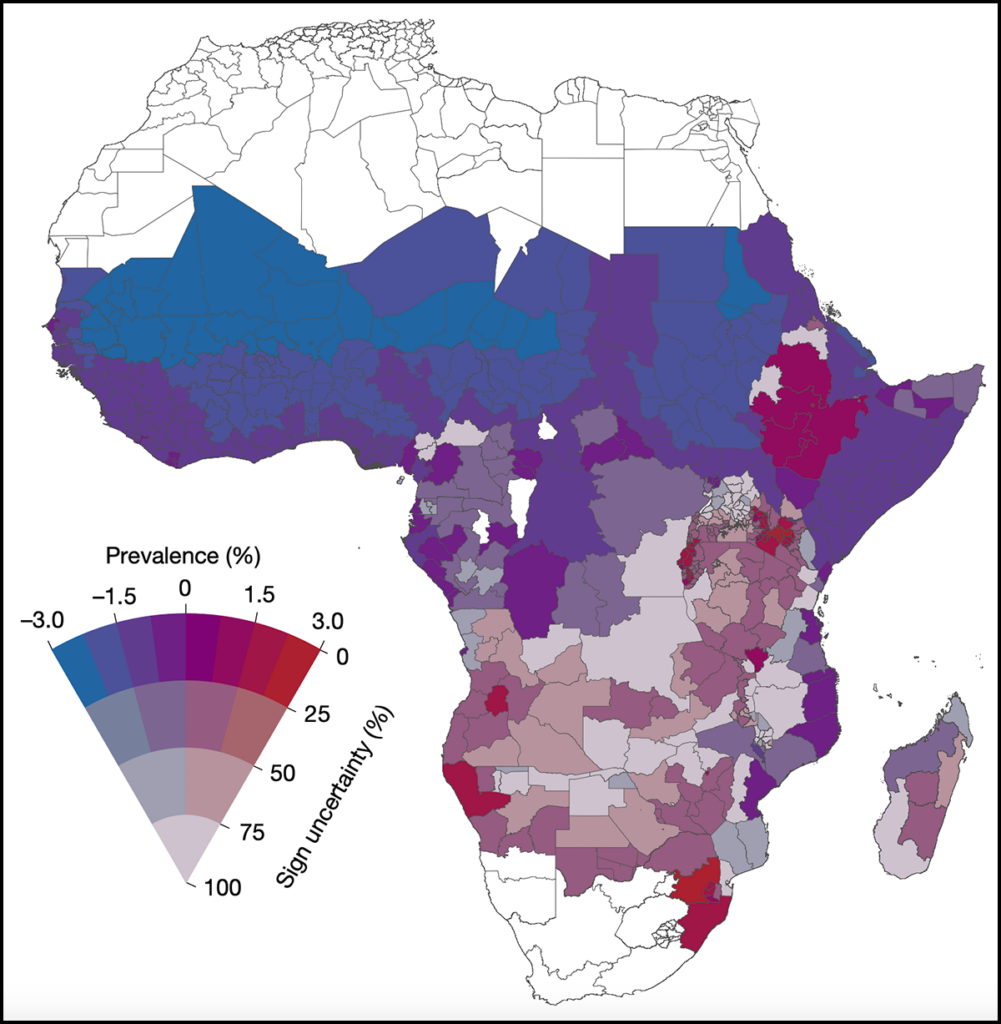
A new study published in Nature offers some clarity in that debate. After analyzing more than 50,000 malaria surveys spanning over a century and decades of climate data, researchers found that warming temperatures in sub-Saharan Africa have already made some places too hot for transmission, lowering malaria prevalence. Other regions have become better habitat for mosquitoes and their parasites over time. Researchers expect the trend to continue, amplifying changes in malaria prevalence across the continent as climate change persists.
“The story is really not [about] net aggregate effects across the large and diverse continent of Africa,” said Tamma Carleton, an environmental economist at the University of California, Berkeley, and a coauthor of the new study. “This is a story about a shifting burden across space.”
The Role of Climate Change
To study how climate change has affected malaria prevalence, researchers borrowed methods from climate attribution research, which uses climate modeling and comparisons to a hypothetical world without human-caused climate change to determine the extent to which climate change played a role in a specific weather event. The confidence of such studies is improving for weather events, but the methods aren’t typically used to attribute public health phenomena such as malaria prevalence.
“We build on top of well-developed climate attribution science methods but face additional complexities because we’re trying to trace impacts on human outcomes,” Carleton said. In health fields, in particular, there are very few examples of studies that causally link historical anthropogenic emissions to observed health outcomes, she said. She hopes the methods presented in the new study can help other researchers further investigate the link between climate change and human health outcomes.
In their analysis, the researchers focused on childhood malaria prevalence because about 95% of global malaria cases are experienced by children between 2 and 10 years of age throughout parts of central, eastern, southern, and western Africa. Results showed that climate change has already reshaped malaria prevalence in the region since 1901.
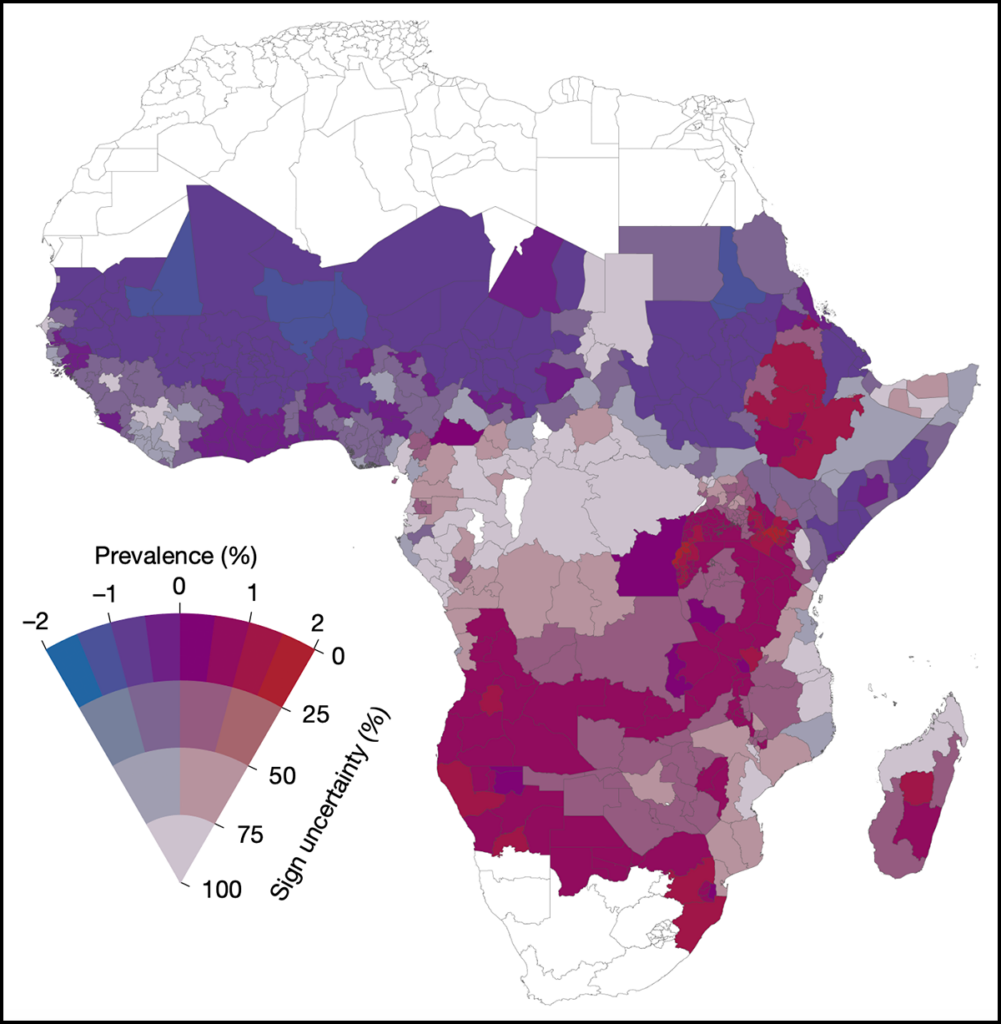
In particular, human-caused climate change has slightly increased malaria prevalence across Africa, adding about 1 excess case per 1,000 children since 1901. Rising temperatures have created better conditions for malaria transmission in East and southern Africa. But hotter weather in West and central Africa has made the region too hot for transmission to occur, lowering malaria prevalence.
The changes are “modest” compared to observed reductions in malaria prevalence that have occurred as a result of eradication campaigns alongside economic development, Carleton said. Erin Mordecai, an infectious disease ecologist at Stanford University who was not involved in the new research, wrote in an email that the claims in the paper about climate change driving increased malaria burden are nuanced.
“This may be subtly true, to a small extent, in some regions like southern and highland east Africa, where temperatures were previously sub-optimal. At the same time, even in these places the effects of climate change are small” compared to other drivers such as malaria control programs, she wrote.
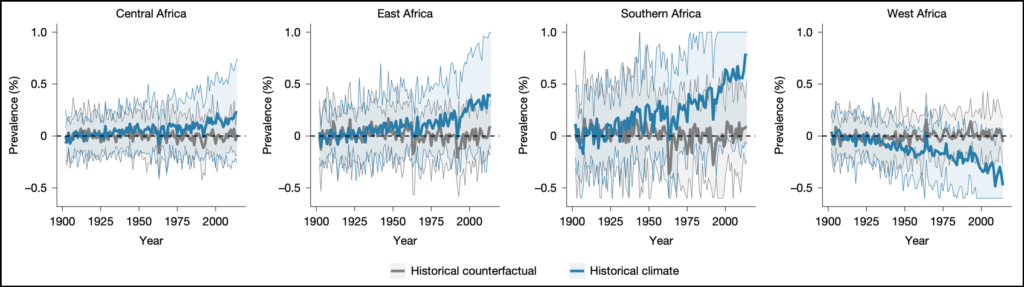
To Mordecai, the most exciting aspect of the study was its confirmation of the “thermal biology of malaria transmission”—the study’s results show clear changes in transmission when temperatures go up or down. “The fact that this was predicted…and [is] now validated at such a large scale is very compelling,” she wrote.
Amplified Patterns
As the climate continues to change, the trends the researchers noticed “amplify in ways that really do start to shape the policy conversation,” Carleton said.
“It’s important to show that the burden of malaria is shifting away from those very hot places, but that also means many other threats to public health are unfolding as the temperatures get extremely, extremely hot.”
Carleton and the team projected changes in childhood malaria prevalence up to 2100 using data on past climate and disease prevalence for multiple future climate change scenarios. They found that rising temperatures will continue to reduce disease prevalence in West Africa, particularly under the highest-emissions scenario.
For the rest of Africa, rising temperatures could cause a slight increase in malaria prevalence. Still, temperatures will likely become so hot by the end of the century that the majority of the continent could see more than a 2% decrease in malaria prevalence, a projected reduction that “begins to approach the magnitude of some historical eradication programmes,” according to the authors.
Carleton emphasized that decreases in malaria presence in warming regions are not exactly cause for celebration—if temperatures are hot enough to halt malaria transmission, they’re hot enough to cause a lot of human suffering, too. “It’s important to show that the burden of malaria is shifting away from those very hot places, but that also means many other threats to public health are unfolding as the temperatures get extremely, extremely hot,” she said.
“Just because malaria risk is going down doesn’t mean aggregate human health and well-being is improving under a future with aggressive emissions.”
Messages for Malaria Eradication
Noticing a shifting disease burden means that policymakers and nongovernmental organizations can begin to “prepare places that have not put this disease at the top of the health priority list,” such as places where, historically, the climate has suppressed transmission, Carleton said. That’s especially important as funding for global health has been dramatically cut in recent years, she added.
“We have to spend each dollar of funding in the way that can alleviate human suffering the most effectively.”
“We have really limited resources going towards prevention of this disease, and we have climate change hitting like a train…This means we have to spend each dollar of funding in the way that can alleviate human suffering the most effectively,” she said.
The projected changes in malaria prevalence could also work in tandem with malaria eradication efforts in some countries, the authors write: “The combined benefits of disease surveillance, healthcare, vector control and economic development can easily counter-balance climate change impacts in most places.”
To Mordecai, the results “highlight the critical importance of control programs for malaria, and these should be sustained even in areas where climate suitability isn’t necessarily increasing,” she wrote. Despite a warming climate, with malaria eradication methods, malaria could still be gone from most of Africa by 2050, according to the study’s authors.
—Grace van Deelen (@gvd.bsky.social), Staff Writer