

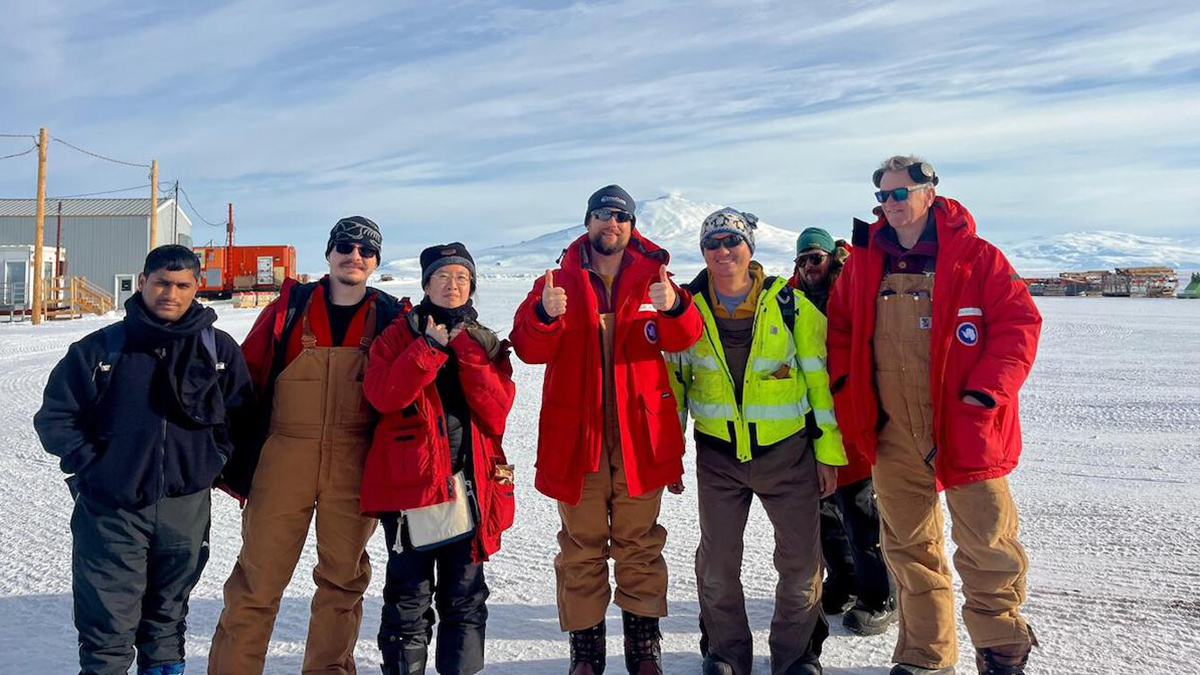
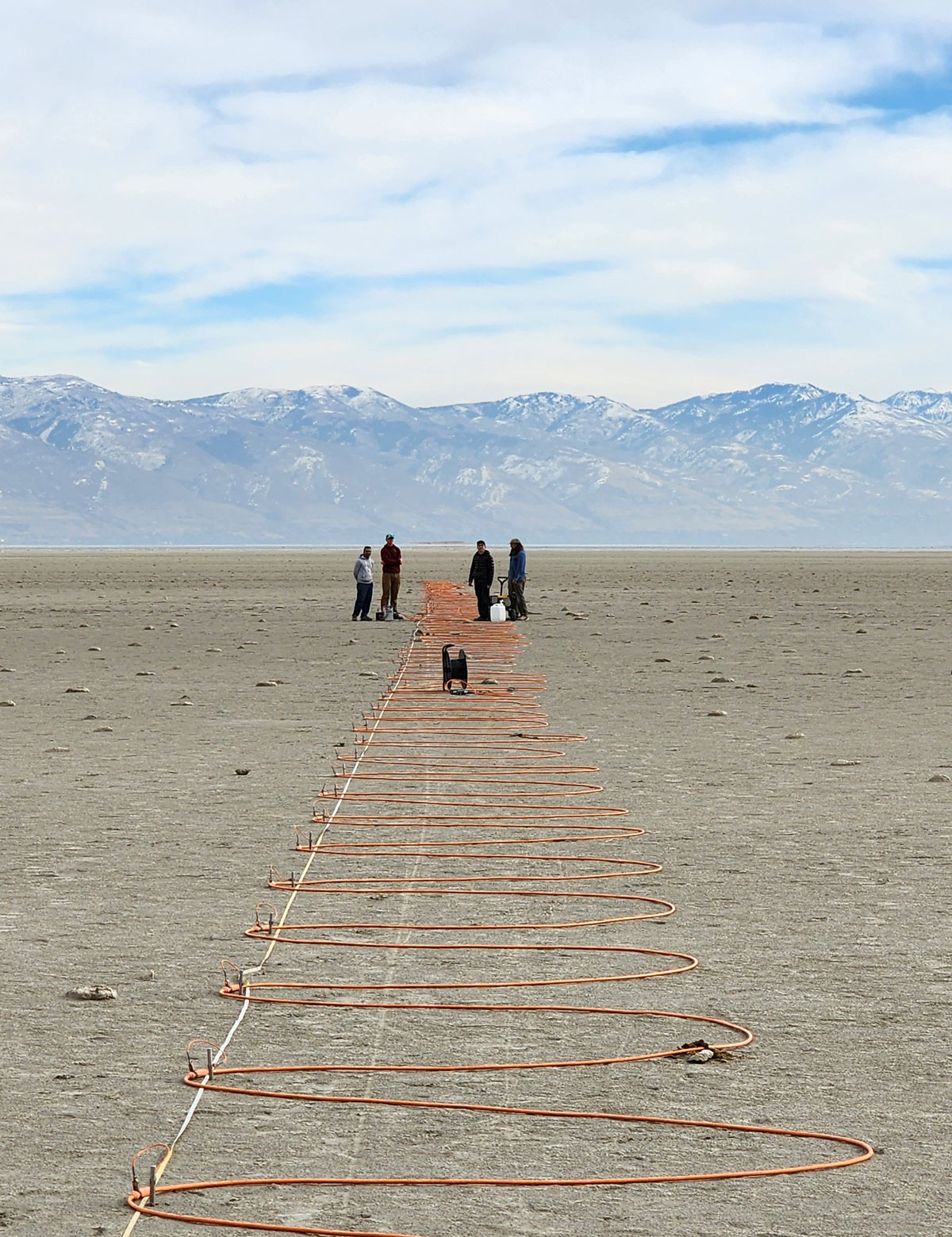
Right now, more than 1.5 miles (2.46 kilometers) below the surface at the South Pole, lie two seismometers—the deepest of their kind—built to withstand the extreme pressure, cold, and magnetic interference in one of Earth’s harshest environments.
Deploying the instruments, which will be part of the U.S. Geological Survey’s (USGS) Global Seismographic Network, was a “hail Mary” expedition because of the challenges faced, said Robert Anthony, a geophysicist in the Earthquake Hazards Program at the USGS who led the National Science Foundation (NSF)–funded project.
“That they’re functioning a mile and a half deep in the ice is just incredible,” he added.
Now that the instruments have been successfully deployed, they’ll start collecting high-quality seismic information that scientists can use to measure earthquakes, detect tsunamis, and even monitor nuclear testing.
The new seismometers help “fill an enormous, continent-scale gap in our high-quality coverage of the Earth,” said Rick Aster, a seismologist at Colorado State University who was part of the technical review process for the seismometers. “Having a good distribution of stations around the world is a great thing for seismology and Earth science.”
Engineering Under Pressure
Creating seismometers that can withstand being buried in an ice sheet took years of planning, dozens of experts across many organizations, and cold, difficult work at the bottom of the world.
Each seismometer sits at the bottom of a borehole drilled as part of an NSF partnership with the USGS Albuquerque Seismological Laboratory, University of Wisconsin–Madison, and IceCube Neutrino Observatory, which had already been installing subsurface instruments to detect subatomic particles. The holes were drilled with hot water, meaning each is still filled with water that is slowly expanding as it freezes. This “violent, chaotic process,” said Anthony, is exerting extreme pressure on the seismometers, which must be capable of withstanding up to 8,500 pounds per square inch (58,605 kilopascals)—nearly 500 times the pressure of Earth’s atmosphere at sea level.
To protect them, each seismometer is held by a pressure vessel, first created for IceCube’s dark matter experiments, that can withstand about 10,000 pounds per square inch (68,948 kilopascals). The seismometers are also protected from magnetic storms, which can be particularly intense at the poles, with a metal covering that redirects the magnetic field around the instruments.
A scientific instrument company called Nanometrics helped the team determine how to mount the seismometers within the pressure vessels, while IceCube adapted their existing methods to create a system to allow the instruments to receive GPS signals far below the ice sheet’s surface.
“There’s such a high chance of failure, so many things that can go wrong, that it’s amazing that they both were installed and that they’re both functional.”
The team finally had a fully operational product in July 2025, just 2 months before the shipping deadline to get the equipment to Antarctica. If their engineering solutions had taken just a month longer, the project may not have gone forward, Anthony said. In the 2 months before shipping, the instruments underwent extensive testing at the Albuquerque Seismological Laboratory, Michigan State University, and the University of Wisconsin.
Anthony said he expects the seismometers, deployed during the Antarctic summer on 30 December and 9 January, to freeze fully into the ice within the next few months. Having them deployed is a “huge relief,” said David Wilson, director of the USGS Global Seismographic Network and a geophysicist involved in the project. “There’s such a high chance of failure, so many things that can go wrong, that it’s amazing that they both were installed and that they’re both functional.”
Seismological Knowledge
The two seismometers will be able to record the movement of the planet after large earthquakes and pick up fainter signals with greater fidelity than any previously deployed instruments. The South Pole is the only place on Earth where seismometers can make such observations without distortion from Earth’s rotation.
Also, the depth and location of the instruments mean they’re far from any surface noise, such as human activity, ocean waves, or wind. Even changes to atmospheric pressure, such as when storms roll in, can affect seismic data. The deeper seismometers are placed, the less those changes affect the instruments. Firn—dense snow in the process of compressing to glacial ice—also dampens surface noise.
Aster likens the installation of the instruments to astronomers trying to find the darkest sky to observe. “This is a vibrational sensor looking for the vibrationally quietest part of the world,” he said.
And because both seismometers will be frozen into the ice sheet, they will be extremely still and will remain so for a very long time. With such stable seismometers, “you can record minute ground motions, on the order of almost the size of an atom—very, very tiny ground motions,” Anthony said.
The data from the seismometers could answer long-held questions about seismic activity in Antarctica, such as how its ice sheet is moving over bedrock. In places, the ice sheet could be sticking and slipping “in a way that we can observe at a new level of fidelity” using the new seismometers, Aster said. The instruments will also capture unique measurements of the seismic activity of icebergs off Antarctica’s coast and volcanoes in West Antarctica, he said.
The installation of these instruments showcases the value of having a U.S. science presence in Antarctica, Aster added. The South Pole station provides “an absolutely unique and world-class capability” for the U.S. scientific enterprise, he said.
—Grace van Deelen (@gvd.bsky.social), Staff Writer