
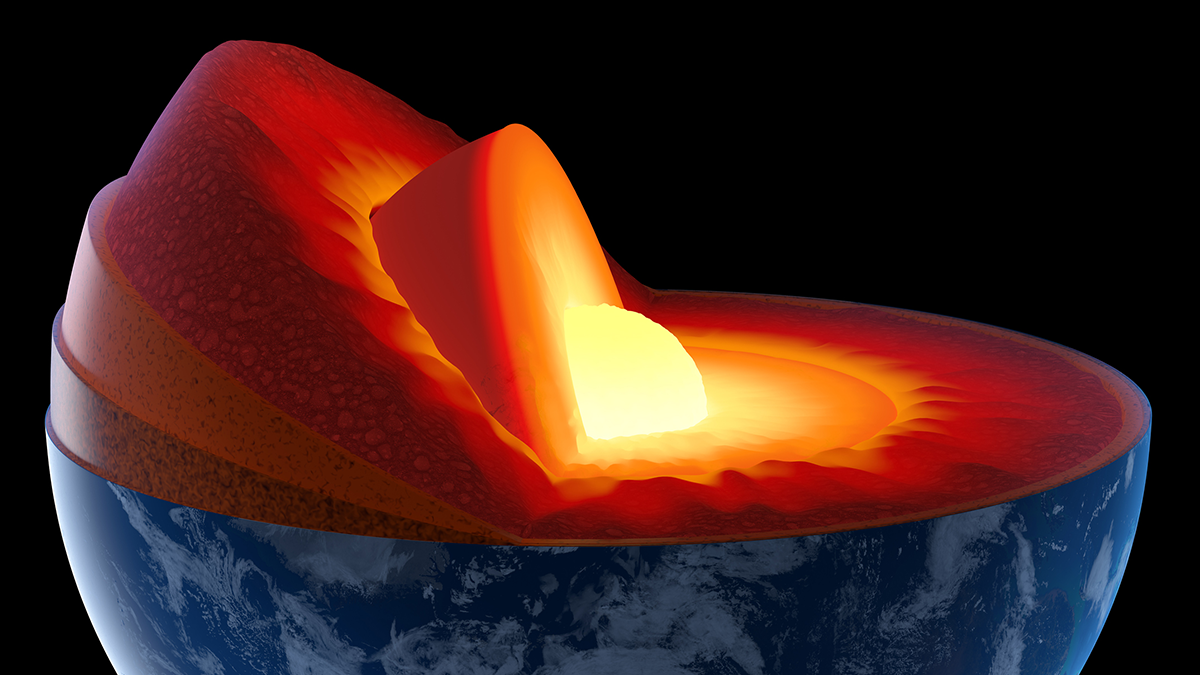
At depths below 1,000 kilometers in Earth’s mantle, pressures exceed 1 million atmospheres, temperatures are hotter than lava at the surface, and rocks behave in ways that defy intuition.
For decades, seismologists have interpreted the structure of this region on the basis of mineral phase transitions that rearrange crystal structures, temperature differences associated with mantle convection, and compositional variations that reflect billions of years of recycling and differentiation. These processes have shaped the standard explanation for why seismic waves travel at different speeds through Earth.
Researchers discovered a distinct fourth contributor to mantle heterogeneities—one that arises from the quantum behavior of electrons in iron ions.
Recently, researchers discovered a distinct fourth contributor to mantle heterogeneities—one that arises from the quantum behavior of electrons in iron ions.
This quantum-scale process occurs within individual atoms, but recent findings show that it can shape planetary-scale structures by influencing the buoyancy, viscosity, and flow of rock in the lower mantle. Research on quantum effects in this region is still in the early stages, but this phenomenon is clearly essential to a fuller understanding of Earth’s deep interior.
Spins Under Pressure
Deep in the lower mantle, iron ions in the two dominant minerals, bridgmanite ((Mg,Fe)(Si,Fe)O3) and ferropericlase ((Mg, Fe)O), undergo a pressure-driven rearrangement of their electronic structure known as a spin transition. In this process, some electrons in the iron ions change from a “high-spin” configuration to a “low-spin” one (more details are given below). No chemical bonds are broken, and mineral crystal symmetries remain unchanged. But the affected iron ions shrink, their bonds stretch, and their volume collapses.
High-pressure experiments revealed this electronic transformation in the laboratory 2 decades ago [e.g., Badro et al., 2003; Lin et al., 2005; Komabayashi et al., 2010]. At the time, the potential implications for mantle structure and behavior were considered potentially important but speculative. If this phenomenon is subtle, can it matter at the scale of continents and convection flows? The answer has emerged only gradually.
Spin is an intrinsic property of single ions. The populations of high- and low-spin iron ions in the mantle change continuously with pressure and temperature [Tsuchiya et al., 2006], a phenomenon known as the iron spin crossover (ISC). As the proportions of these spin states change, the compressibility of the ions’ host mineral phases is altered [Wentzcovitch et al., 2009].
Because the iron spin crossover (ISC) affects a mineral’s compressibility, it leaves a distinctive imprint on P wave speeds, whereas S wave speeds change much less.
Ferropericlase makes up about 20% of the lower mantle volume, but it is the mantle mineral with the highest per-mole iron content. Therefore, the ISC is most detectable in this phase. Meanwhile, the ISC in bridgmanite is less detectable and may have a less significant effect on compressibility, even though bridgmanite constitutes up to 80% of the lower mantle.
The explanation may be that in the bridgmanite crystal structure, iron usually occupies a less compressed position within a silica framework. To be compressed sufficiently to undergo the ISC, iron in bridgmanite has to replace some of the silicon ions in the mineral’s smaller octahedral site. This replacement does not happen easily because the mantle contains enough aluminum and silicon to complete the octahedral framework without stretching to accommodate the larger iron ions.
Compressional seismic waves (P waves) respond to changes in the compressibility of the material through which they are traveling more than shear waves (S waves) do. Because the ISC affects a mineral’s compressibility, it leaves a distinctive imprint on P wave speeds, whereas S wave speeds change much less [Wu et al., 2013]. This difference is hidden in plain sight. Only when mineral physics and 3D seismic imaging were brought together did the consequences become clear.
The Physics of a Spin Crossover
The ISC is strictly a quantum phenomenon. In a high-spin state, electrons occupy separate atomic orbitals with parallel spins, resulting in a larger ion with a larger volume. In a low-spin state, electrons pair within lower-energy orbitals, reducing both spin and ionic volume. The temperature at any given depth determines the relative abundances of these different spin states (Figure 1).
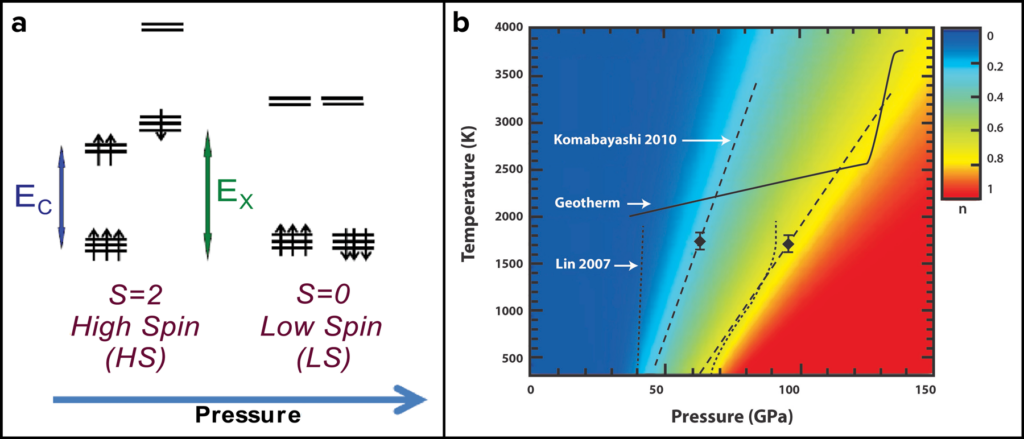
At lower pressures, iron in both ferropericlase and bridgmanite remains in the high-spin state, but increasing pressure stabilizes the low-spin configuration. Laboratory measurements have shown that the spin states of iron ions begin to change at depths near 1,000 kilometers and continue well past 2,000 kilometers, covering most of the lower mantle [Lin et al., 2007].
Experiments and ab initio (first-principles) calculations have similarly indicated that the ISC does not create a sharp seismic discontinuity in the mantle [Lin et al., 2007; Wu and Wentzcovitch, 2014; Zhuang and Wentzcovitch, 2024]. Instead, it produces a broad, mixed-spin region in which high- and low-spin states coexist (Figure 1b), each with its characteristic ionic volume and local strains.
Those structural subtleties and the changes in the population of these iron spin states under pressure alter the minerals’ responses to compression.
From Quantum Physics to Seismic Velocities
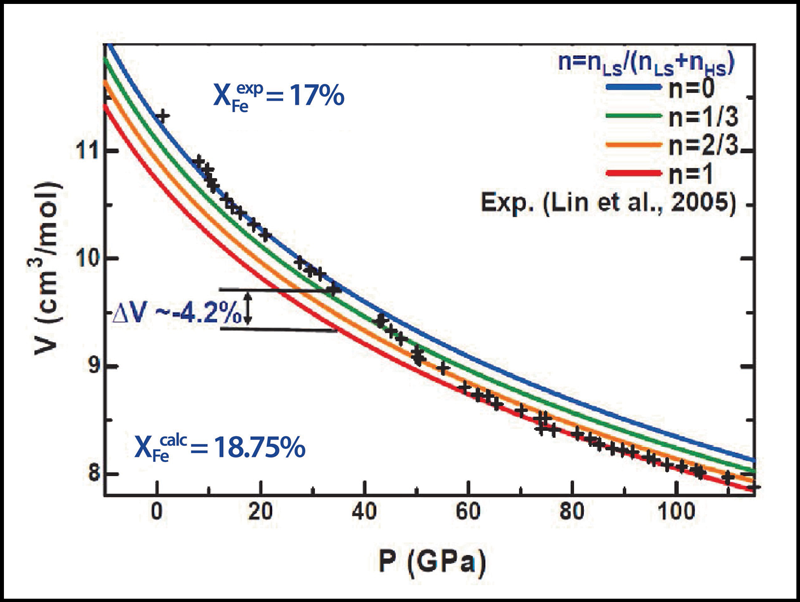
The gradual, pressure-induced ISC reduces ferropericlase’s bulk modulus, or its resistance to compression (Figure 2). Meanwhile, the mineral’s shear modulus, its resistance to shape deformation, gently increases [Wu et al., 2013]. Because P wave velocities depend on both moduli and S wave velocities depend on the shear modulus but not the bulk modulus, the ISC reduces P wave velocities with increasing depth, whereas S wave velocities increase slightly with depth.
A breakthrough in understanding these trends came when advanced ab initio simulations revealed that the elastic signature of the ISC (i.e., its response to applied force) is very diffuse [Zhuang and Wentzcovitch, 2024]. This signature spans most of the lower mantle, broadly reducing P wave speeds rather than causing an abrupt drop. Because the ISC is temperature dependent, these broad variations are even less obvious when 3D seismic wave speeds are spherically averaged, making them less apparent in 1D models (Figure 3).
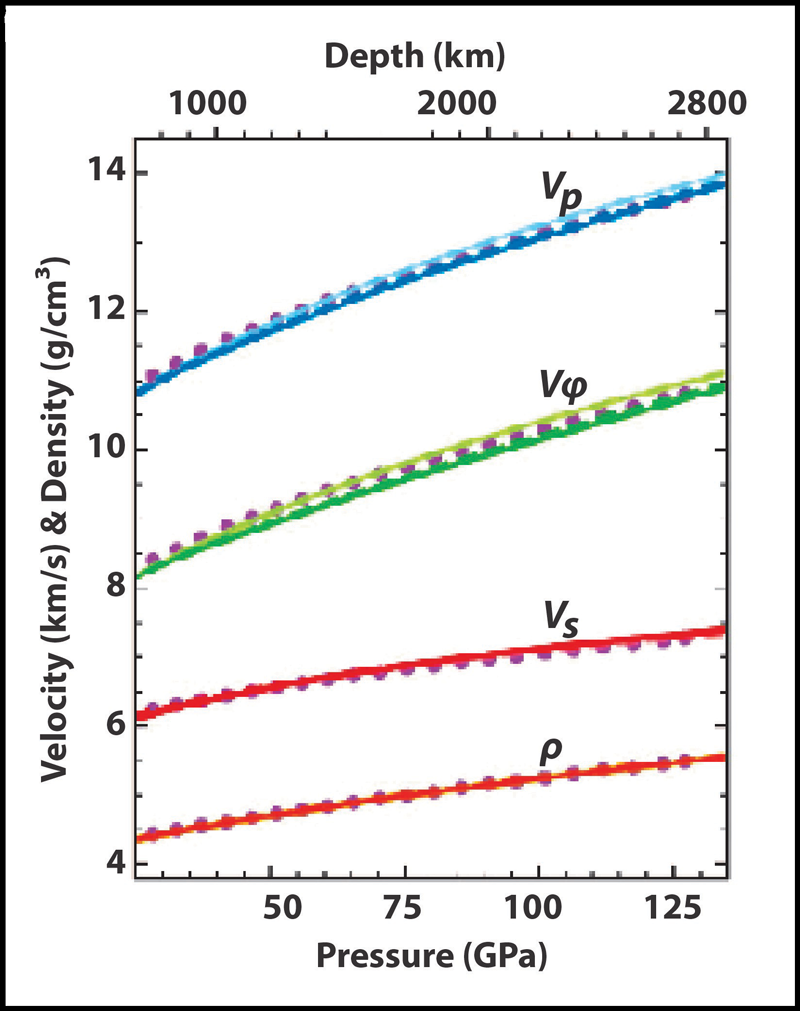
These updated simulations also showed that the ISC-induced reduction in P wave speeds is unavoidable. Models that infer mantle temperatures from seismic velocities typically do not account for this reduction, leading to unrealistically low temperatures and extreme compositions [Cobden et al., 2024]. The ISC acts as a background correction in calculations of temperature and composition: essential but invisible unless explicitly accounted for (Figure 3).
This insight set the stage for a new way of looking at seismic data, not through 1D radial averages, but through the 3D relationships between P and S wave speeds.
A Seismological Signature Noticeable in 3D
Where the ISC becomes strikingly evident is in the difference between compressional wave and shear wave speed anomalies induced by temperature variations (Figure 4). Because temperature affects P wave speeds differently than S wave speeds, regions containing ferropericlase should show muted P wave anomalies relative to their S wave anomalies.
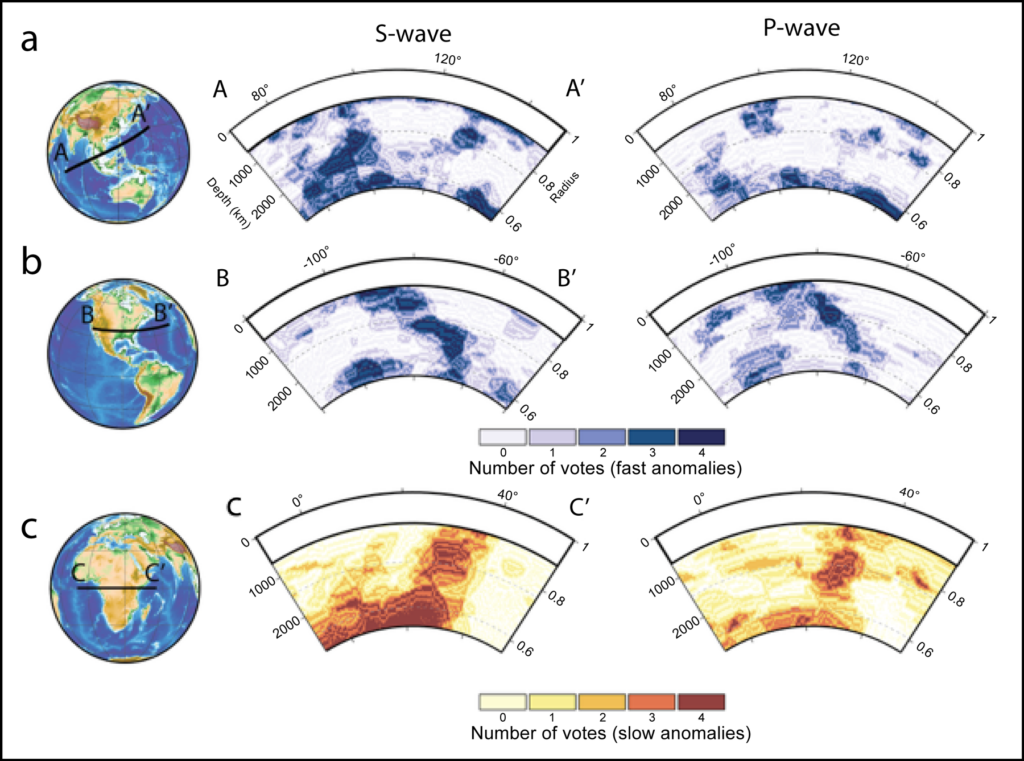
Slabs of subducted oceanic lithosphere, for example, have faster wave speeds than the ambient mantle because they are colder and harder to compress. Thermodynamic models suggest that the ISC should dampen P wave speed anomalies but not S wave speed anomalies in these slabs, producing a diagnostic pattern of decorrelation between P and S wave speeds.
This effect was recognized by Wu and Wentzcovitch [2014], but the first global-scale evidence of it appeared when Shephard et al. [2021] used “vote maps” to highlight consistent features across many independent tomography models (i.e., how many models agree on, or “vote” for, the presence of a feature). The vote maps showed that in the lower mantle, P and S wave structures diverge precisely where ferropericlase is expected to be in a mixed-spin state.
These findings form a consistent narrative: The ISC is not expressed as a sharp or diffuse “layer” in the mantle, but through 3D contrasts between P and S wave structures.
More recently, Cobden et al. [2024] used full-waveform tomography to obtain absolute values of P and S wave speeds. Their results showed that reproducing observed velocities with realistic temperatures and compositions requires inclusion of the ISC; without it, the middle mantle would have to be unrealistically cold and strongly depleted of silicon.
Although the influence of the ISC on the ratio of temperature-induced S wave to P wave variations was previously recognized, a full treatment of the ISC in ferropericlase has been shown to quantitatively reconcile mineral physics predictions with seismological observations [Wu and Wentzcovitch, 2014; Zhuang and Wentzcovitch, 2024].
Together, these findings form a consistent narrative: The ISC is not expressed as a sharp or diffuse “layer” in the mantle, but through 3D contrasts between P and S wave structures.
The Iron Spin Crossover Quietly Reshapes the Mantle
New understanding from recent research affirms several consequential points for geophysical studies. First, the ISC reshapes interpretations of deep-mantle seismic structure. Seismic heterogeneity reflects not only temperature, phase, and composition changes but also variations in spin state abundances. Temperature-dependent changes in high- and low-spin iron populations directly influence seismic wave speeds.
Second, accounting for ISC effects yields more realistic mantle temperatures in interpretations based on full-waveform tomography. Without these effects, models indicate unrealistically cold or extreme compositions.
Third, mixed-spin ferropericlase densifies more rapidly with increasing pressure. This densification invigorates mantle convection [Bower et al., 2009] and may reduce its viscosity, potentially influencing tectonic processes such as slab sinking and stagnation, as well as plume rising and morphology.
The ISC illustrates how quantum-scale processes shape planetary-scale behavior.
On a broader scale, the ISC illustrates how quantum-scale processes shape planetary-scale behavior. Rather than producing sharp seismic boundaries, it introduces subtle, pervasive effects on wave speeds and their relationships in 3D.
The ISC provides seismologists with a framework for reconciling mantle temperatures, compositions, and wave speed anomalies. It also highlights for mineral physicists the importance of electronic structure and suggests to geodynamicists that electron spin may influence buoyancy, viscosity, and flow. Further, it shows that key processes in Earth’s interior can remain hidden until multiple disciplines integrate their expertise and efforts.
As seismic imaging improves and mineral physics models become more accurate, the ISC’s role in shaping lower mantle structure and dynamics will become clearer. Indeed, revealing its influence on prominent but not fully understood phenomena such as large low shear velocity provinces, the Dʺ discontinuity and layer, and slab stagnation zones is an active area of research. What is already clear is that the ISC is a global, depth-spanning process essential to understanding Earth’s deep interior.
References
Badro, J., et al. (2003), Iron partitioning in Earth’s mantle: Toward a deep lower mantle discontinuity, Science, 300(5620), 789–791, https://doi.org/10.1126/science.1081311.
Bower, D. J., et al. (2009), Enhanced convection and fast plumes in the lower mantle induced by the spin transition in ferropericlase, Geophys. Res. Lett., 36, L10306, https://doi.org/10.1029/2009GL037706.
Cobden, L., et al. (2024), Full-waveform tomography reveals iron spin crossover in Earth’s lower mantle, Nat. Commun., 15, 1961, https://doi.org/10.1038/s41467-024-46040-1.
Komabayashi, T., et al. (2010), High-temperature compression of ferropericlase and the effect of temperature on iron spin transition, Earth Planet. Sci. Lett., 297, 691–699, https://doi.org/10.1016/j.epsl.2010.07.025.
Lin, J.-F., et al. (2005), Spin transition of iron in magnesiowüstite in the Earth’s lower mantle, Nature, 436, 377–380, https://doi.org/10.1038/nature03825.
Lin, J.-F., et al. (2007), Spin transition zone in Earth’s lower mantle, Science, 317, 1,740–1,743, https://doi.org/10.1126/science.1144997.
Shephard, G. E., et al. (2021), Seismological expression of the iron spin crossover in ferropericlase in the Earth’s lower mantle, Nat. Commun., 12, 5905, https://doi.org/10.1038/s41467-021-26115-z.
Tsuchiya, T., et al. (2006), Spin transition in magnesiowüstite in Earth’s lower mantle, Phys. Rev. Lett., 96, 198501, https://doi.org/10.1103/PhysRevLett.96.198501.
Wentzcovitch, R. M., et al. (2009), Anomalous compressibility of ferropericlase throughout the iron spin cross-over, Proc. Natl. Acad. Sci. U. S. A., 106, 8,447–8,452, https://doi.org/10.1073/pnas.0812150106.
Wu, Z., and R. M. Wentzcovitch (2014), Spin crossover in ferropericlase and velocity heterogeneities in the lower mantle, Proc. Natl. Acad. Sci. U. S. A., 111, 10,468–10,472, https://doi.org/10.1073/pnas.1322427111.
Wu, Z., et al. (2013), Elastic anomalies in a spin-crossover system: Ferropericlase at lower mantle conditions, Phys. Rev. Lett., 110, 228501, https://doi.org/10.1103/PhysRevLett.110.228501.
Zhuang, J., and R. Wentzcovitch (2024), Fe2+ partitioning in Al-free pyrolite: Consequences for seismic velocities and heterogeneities, Geophys. Res. Lett., 51, e2024GL108967, https://doi.org/10.1029/2024GL108967.
Author Information
Renata Wentzcovitch ([email protected]), Department of Earth and Environmental Science and Department of Applied Physics and Applied Mathematics, Lamont-Doherty Earth Observatory, Columbia University, New York; Laura Cobden, Utrecht University, Utrecht, Netherlands; Christine Houser, Earth-Life Science Institute, Tokyo; Grace Shephard, Research School of Earth Sciences, Australian National University, Canberra; and Jingyi Zhuang, Department of Earth and Environmental Science, Lamont-Doherty Earth Observatory, Columbia University, New York