Source: Earth’s Future
Greenhouse gas emissions are heating our atmosphere and oceans, and turning seawater more acidic. One of the myriad expected impacts of these conditions is a reduction in farming yields of shellfish, such as oysters and mussels. Coastal communities worldwide rely on these organisms for their economies and as a major food supply. However, exactly how climate change will affect oyster and mussel farming is not yet clear.
Using a novel experimental setup, Pernet et al. report new projected yields of oyster and mussel farming in the Mediterranean Sea for the years 2050, 2075, and 2100. Their results suggest that by 2050, yields of both shellfish will drop dramatically, with mussel production perhaps collapsing altogether.
Most prior studies have assessed shellfish in tank experiments under fairly idealized conditions that do not adequately reflect real-world aquaculture settings. This research team took a different approach. They developed a novel system for exposing oysters and mussels in tanks to realistic conditions using water pumped in from the sea, meaning the animals would experience fluctuations in acidity, temperature, and nutrients similar to those experienced by shellfish on nearby farms.
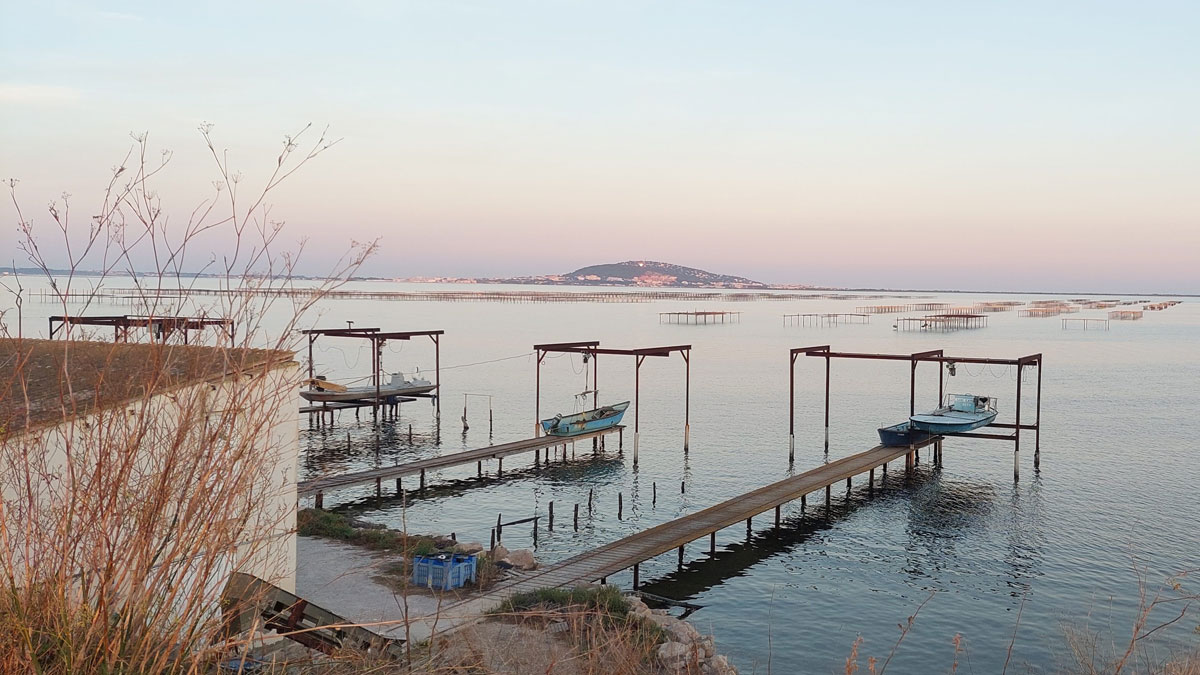
The researchers set up 12 experimental tanks on the French Mediterranean coast in the Thau lagoon, where shellfish farming is key for the local economy. In three tanks, oysters and mussels were exposed directly to pumped-in seawater under present, ambient conditions. The rest of the tanks received seawater that was first warmed and acidified in accordance with widely accepted climate projections for 2050, 2075, and 2100, with three tanks for each year.
The survival rate of oysters in the tanks with predicted 2100 conditions dropped by 7% compared to present rates, and their growth rate dropped by 40%. These results suggest that yields of farmed oysters in the Mediterranean could drop severely over the next several decades.
The mussels fared even worse. In fact, compared to oysters, mussels have a lower range of water temperatures in which they can survive, and the upper limit is already being exceeded in some summertime Mediterranean waters, leading to mass-mortality events. In the experimental tanks under present conditions, mussel mortality was about 40%, and nearly all mussels died under predicted 2050 conditions.
On the basis of these findings, the researchers call for the urgent development of strategies to protect Mediterranean shellfish farming, such as relocating mussel-farming operations to the cooler waters of open seas or developing cofarming with algae to increase resilience to climate change. (Earth’s Future, https://doi.org/10.1029/2025EF005992, 2025)
—Sarah Stanley, Science Writer