• About
  • Special Reports
  • Topics
    • Climate
    • Earth Science
    • Oceans
    • Space & Planets
    • Health & Ecosystems
    • Culture & Policy
    • Education & Careers
    • Opinions
  • Projects
    • Postcards From the Field
    • ENGAGE
    • Editors’ Highlights
    • Editors’ Vox
    • Eos en Español
    • Eos 简体中文版
    • Print Archive: 2015–2025
  • Policy Tracker
  • Blogs
    • Research & Developments
    • The Landslide Blog
  • Newsletter
  • Submit to Eos
  • AGU.org
  • Career Center
  • Join AGU
  • Give to AGU
  • About
  • Special Reports
  • Topics
    • Climate
    • Earth Science
    • Oceans
    • Space & Planets
    • Health & Ecosystems
    • Culture & Policy
    • Education & Careers
    • Opinions
  • Projects
    • Postcards From the Field
    • ENGAGE
    • Editors’ Highlights
    • Editors’ Vox
    • Eos en Español
    • Eos 简体中文版
    • Print Archive: 2015–2025
  • Policy Tracker
  • Blogs
    • Research & Developments
    • The Landslide Blog
  • Newsletter
  • Submit to Eos
Skip to content
  • AGU.org
  • Career Center
  • Join AGU
  • Give to AGU
Eos

Eos

Science News by AGU

Support Eos
Sign Up for Newsletter
  • About
  • Special Reports
  • Topics
    • Climate
    • Earth Science
    • Oceans
    • Space & Planets
    • Health & Ecosystems
    • Culture & Policy
    • Education & Careers
    • Opinions
  • Projects
    • Postcards From the Field
    • ENGAGE
    • Editors’ Highlights
    • Editors’ Vox
    • Eos en Español
    • Eos 简体中文版
    • Print Archive: 2015–2025
  • Policy Tracker
  • Blogs
    • Research & Developments
    • The Landslide Blog
  • Newsletter
  • Submit to Eos

Earth science

Posted inResearch Spotlights

Matching Magma Dikes May Have Different Flow Patterns

Sarah Stanley, Science Writer by Sarah Stanley 30 April 20255 May 2025

A set of lab experiments involving a laser, gelatin, and xanthan gum explored how varying flow patterns between dikes with similar speeds and shapes could affect eruption predictions.

Two graphs from the study.
Posted inEditors' Highlights

Atomic-Scale Insights into Supercritical Silicate Fluids

by Jun Tsuchiya 30 April 202529 April 2025

Water-induced depolymerization enhances fluid mobility in deep Earth, offering new insights into magma transport and isotope signatures in arc lavas.
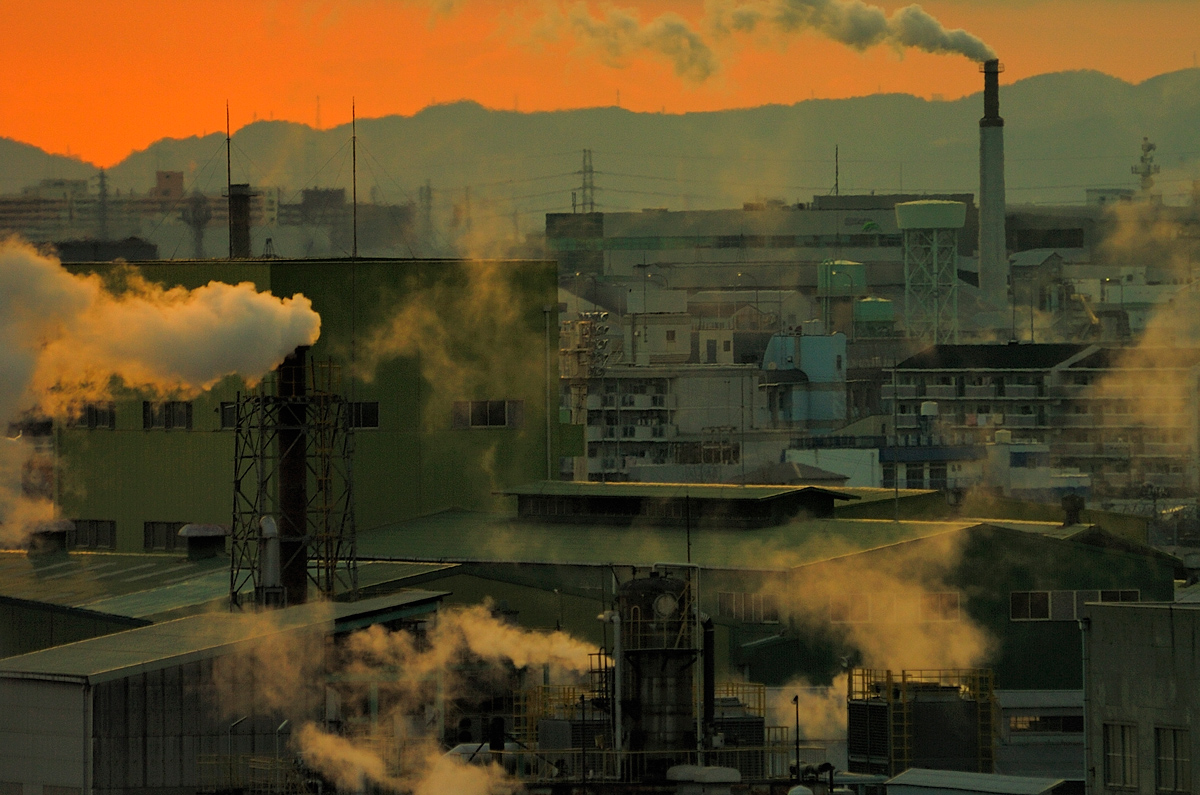
数座高低错落的烟囱将浓烟倾泻在城市上空。从建筑物的顶部可以隐约看到山脉和橙色的天空。
Posted inResearch Spotlights

一些专家认为人类世应得到官方认可

by Saima May Sidik 29 April 20255 May 2025

国际地质科学联合会选择不指定新的地质时代,但这个问题还没有得到解决。

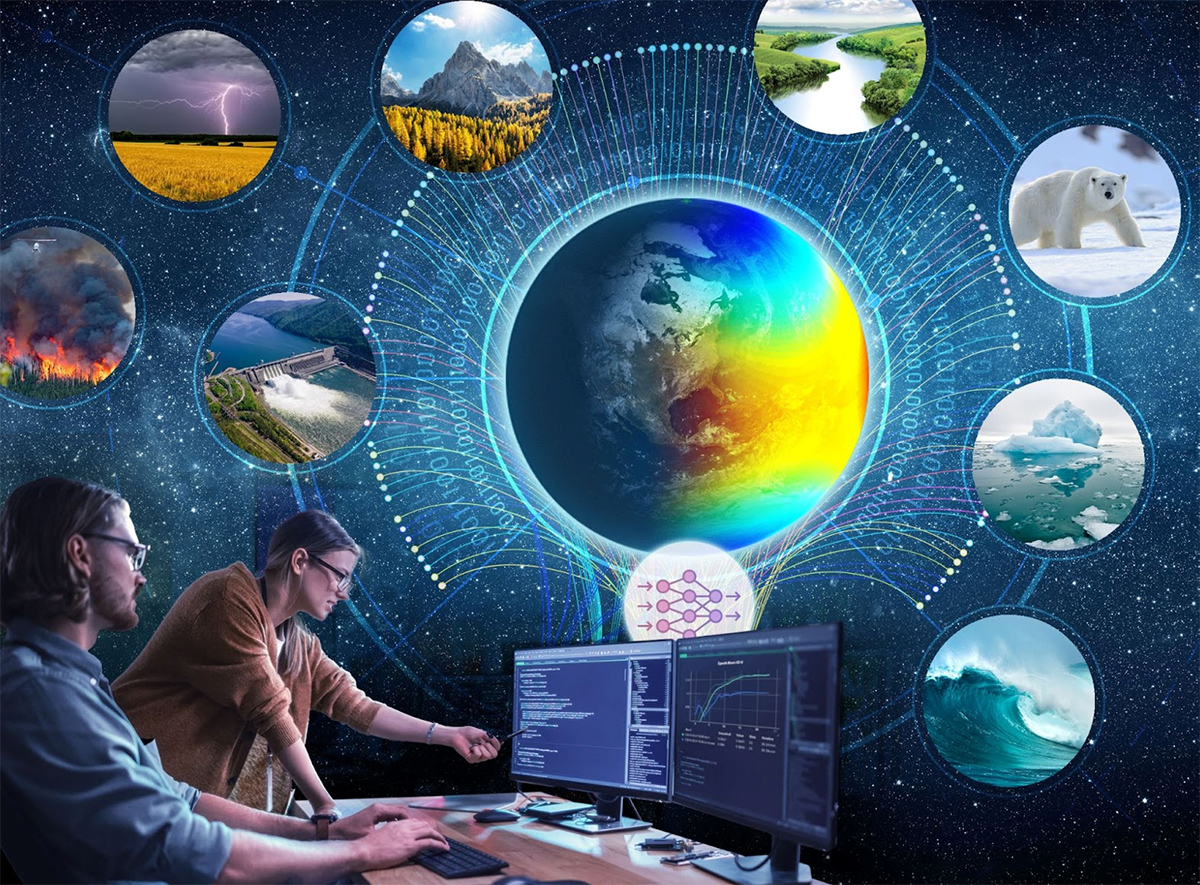
Artificial intelligence–generated depiction of two people looking at computer monitors on a desk, small images of nature scenes in circles representing different Earth science applications, and a depiction of Earth surrounded by zeros and ones representing digital data, all in front of a star-filled night sky background.
Posted inScience Updates

A Two-Step Approach to Training Earth Scientists in AI

by Lexie Goldberger, Peishi Jiang, Tirthankar “TC” Chakraborty, Andrew Geiss and Xingyuan Chen 29 April 202526 February 2026

Researchers learned machine learning methods during a boot camp, then applied their new knowledge to real-world research problems during a hackathon.
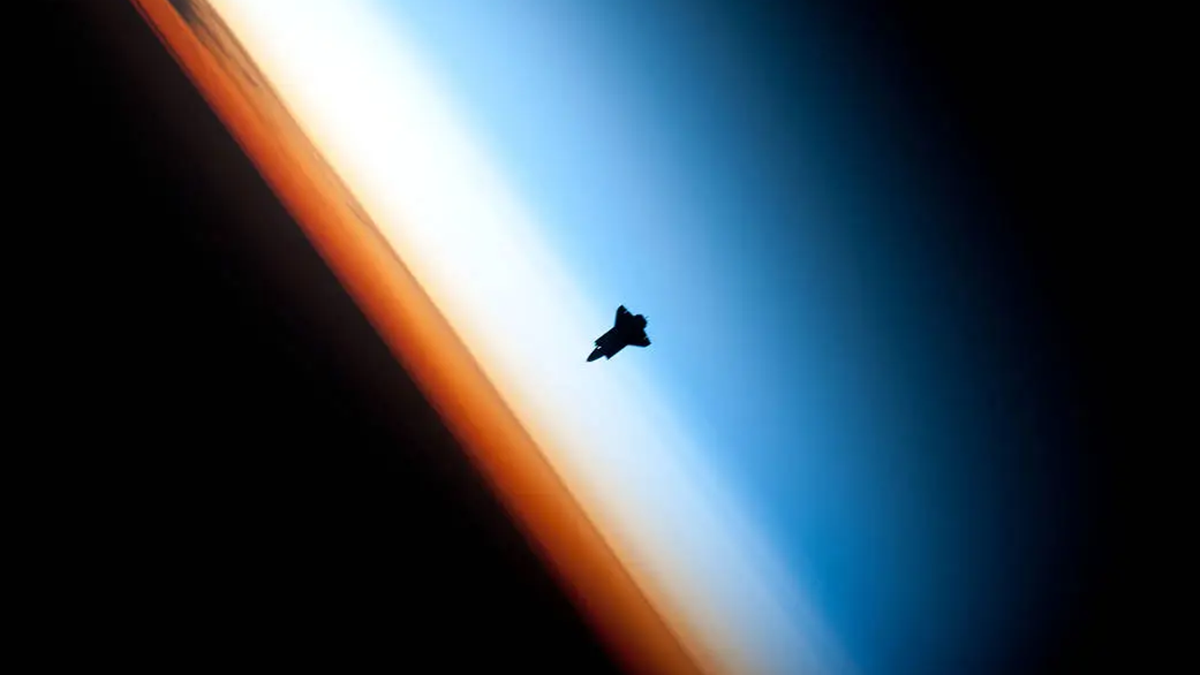
Photo of a space shuttle in front of Earth's atmosphere.
Posted inEditors' Vox

An Air Parcel’s Journey Through the Stratosphere

by Hella Garny 25 April 202525 April 2025

The “age of stratospheric air” measures the speed of the global transport circulation in the stratosphere, which is crucial for understanding the distribution of important trace gases, like ozone.

Cinco personas posan para la cámara con mucho maquillaje y vestuarios coloridos.
Posted inNews

El conocimiento fluye de ida y vuelta en el TierraFest 2025

by Roberto González 25 April 202525 April 2025

El TierraFest, el festival más grande de ciencias de la Tierra en México, adopta la diversidad como medio para compartir el conocimiento de nuestro planeta.
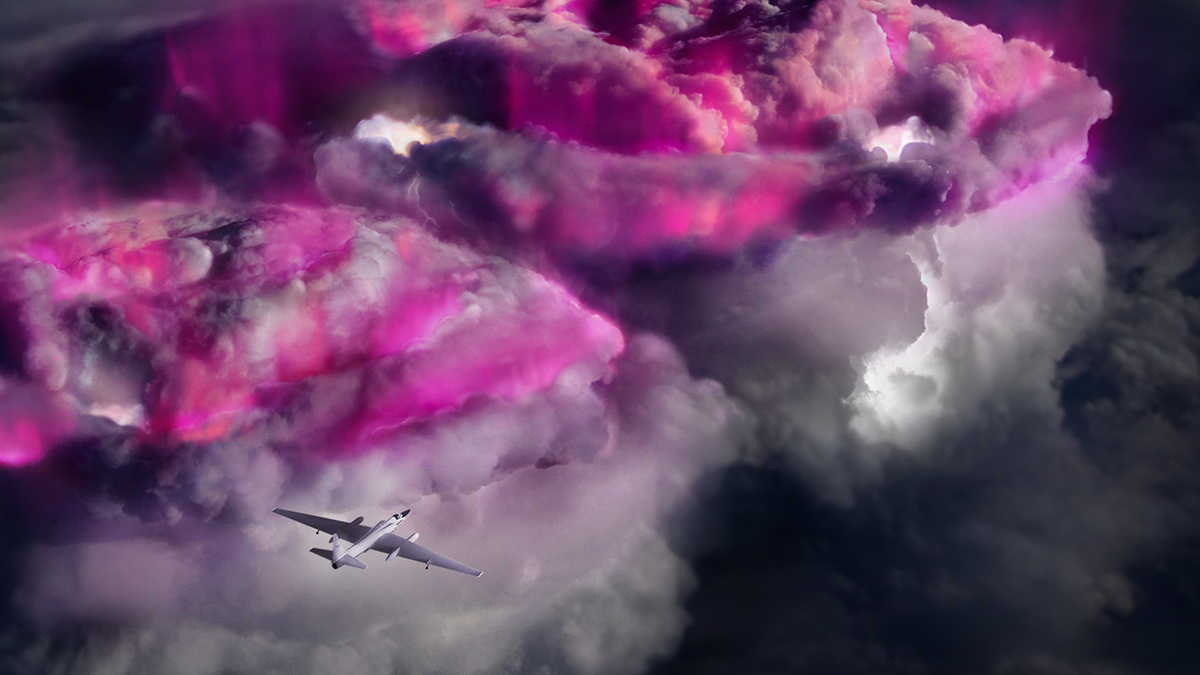
Artist’s conception of an airplane flying above thunderstorm clouds tinted pink to represent gamma ray emissions
Posted inScience Updates

A New View of Gamma Rays from Thunderclouds

by Arve Aksnes, Nikolai Østgaard, Martino Marisaldi and Ingrid Bjørge-Engeland 25 April 202525 April 2025

Observations from high-flying aircraft revealed that thunderclouds act as natural particle accelerators, emitting energetic electromagnetic radiation more often than scientists expected.

Water treatment tank
Posted inAGU News

One Water, Many Solutions

by Caryl-Sue Micalizio 24 April 202526 February 2026

Scientists and stakeholders must engage in broad collaborations and deep research to help ensure safe water supplies.
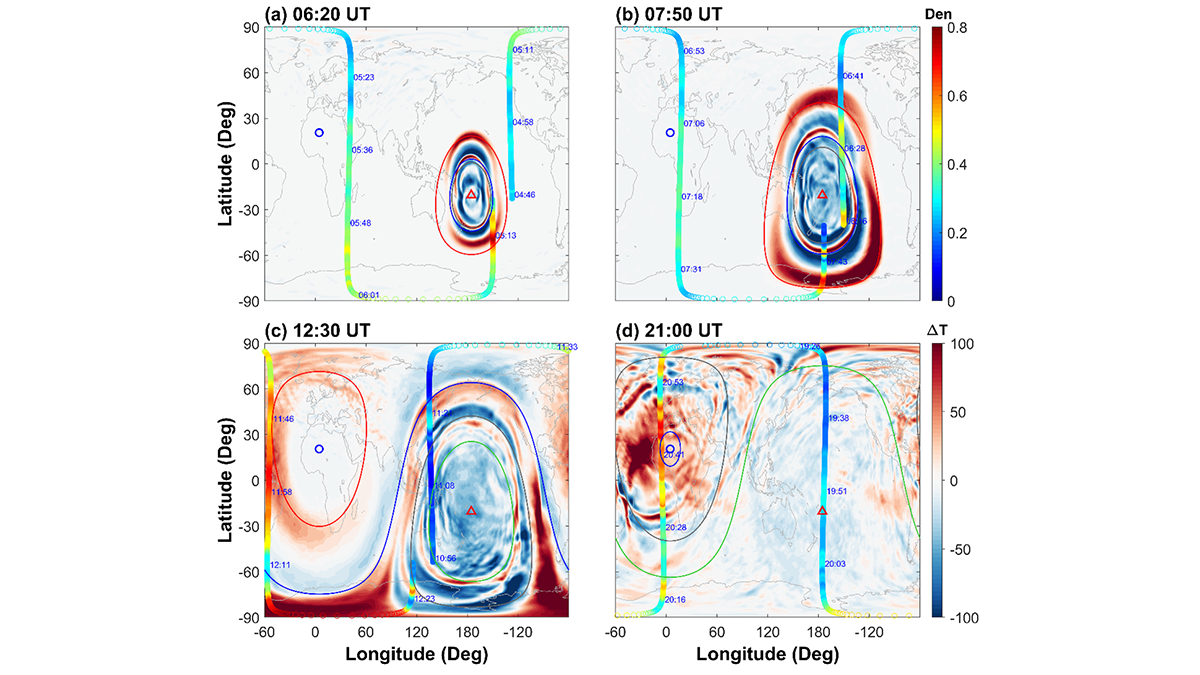
Four images showing the simulation presented in the paper at different timestamps.
Posted inEditors' Highlights

Tonga’s Volcanic Fury Ripples to the Netherworld

by Binzheng Zhang 24 April 202523 April 2025

Secondary gravity waves emerge as the hidden architects of global-scale thermospheric upheaval following the Tonga eruption in 2022.
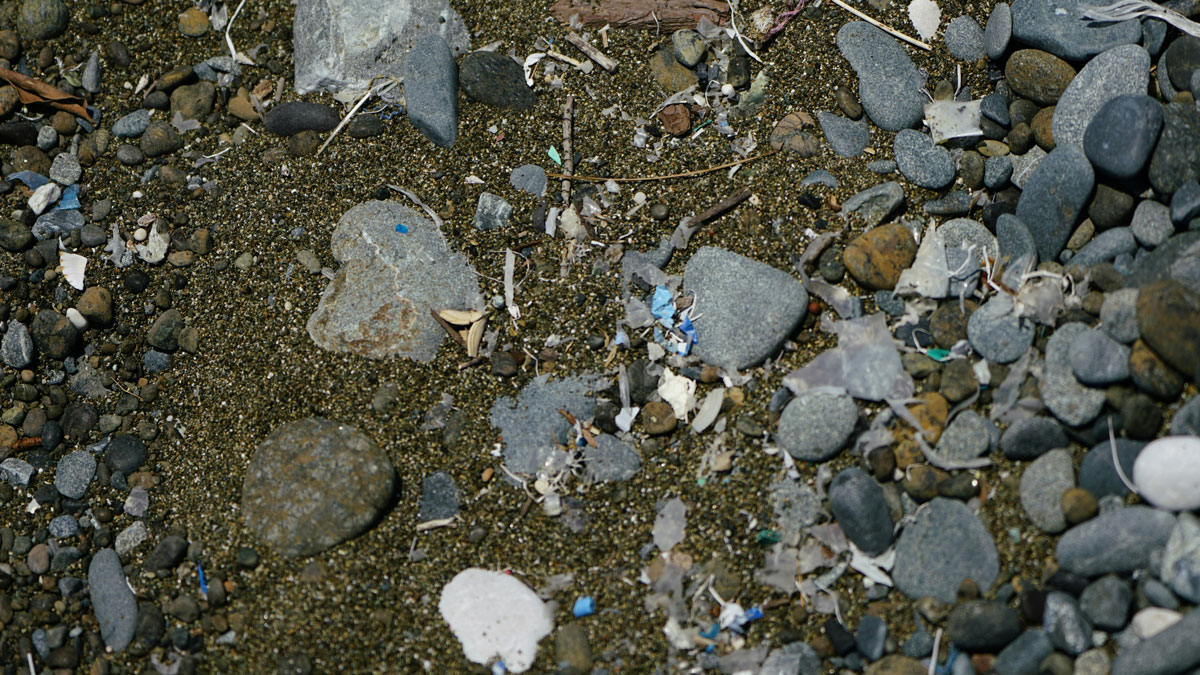
Small plastic fragments on sand and stones.
Posted inNews

Avalanches of Microplastics Carry Pollution into the Deep Sea

by Grace van Deelen 23 April 202523 April 2025

Scientists observed a once-theorized process ferrying microplastics into the deep ocean.

Posts pagination

Newer posts 1 … 29 30 31 32 33 … 160 Older posts
Over a dark blue-green square appear the words Special Report: The State of the Science 1 Year On.

Features from AGU Publications

Research Spotlights

The Speedy Particles That Could Help Us Learn More About Uranus

18 June 202618 June 2026
Editors' Highlights

Where Methane is Emitted Matters for Global Burden

18 June 202616 June 2026
Editors' Vox

Small-Scale Indian Ocean Dynamics Underpin Marine Ecology and Climate

4 June 20263 June 2026
Eos logo at left; AGU logo at right

About Eos
ENGAGE
Awards
Contact

Advertise
Submit
Career Center
Sitemap

© 2026 American Geophysical Union. All rights reserved Powered by Newspack