• About
  • Special Reports
  • Topics
    • Climate
    • Earth Science
    • Oceans
    • Space & Planets
    • Health & Ecosystems
    • Culture & Policy
    • Education & Careers
    • Opinions
  • Projects
    • Postcards From the Field
    • ENGAGE
    • Editors’ Highlights
    • Editors’ Vox
    • Eos en Español
    • Eos 简体中文版
    • Print Archive: 2015–2025
  • Policy Tracker
  • Blogs
    • Research & Developments
    • The Landslide Blog
  • Newsletter
  • Submit to Eos
  • AGU.org
  • Career Center
  • Join AGU
  • Give to AGU
  • About
  • Special Reports
  • Topics
    • Climate
    • Earth Science
    • Oceans
    • Space & Planets
    • Health & Ecosystems
    • Culture & Policy
    • Education & Careers
    • Opinions
  • Projects
    • Postcards From the Field
    • ENGAGE
    • Editors’ Highlights
    • Editors’ Vox
    • Eos en Español
    • Eos 简体中文版
    • Print Archive: 2015–2025
  • Policy Tracker
  • Blogs
    • Research & Developments
    • The Landslide Blog
  • Newsletter
  • Submit to Eos
Skip to content
  • AGU.org
  • Career Center
  • Join AGU
  • Give to AGU
Eos

Eos

Science News by AGU

Support Eos
Sign Up for Newsletter
  • About
  • Special Reports
  • Topics
    • Climate
    • Earth Science
    • Oceans
    • Space & Planets
    • Health & Ecosystems
    • Culture & Policy
    • Education & Careers
    • Opinions
  • Projects
    • Postcards From the Field
    • ENGAGE
    • Editors’ Highlights
    • Editors’ Vox
    • Eos en Español
    • Eos 简体中文版
    • Print Archive: 2015–2025
  • Policy Tracker
  • Blogs
    • Research & Developments
    • The Landslide Blog
  • Newsletter
  • Submit to Eos

geology

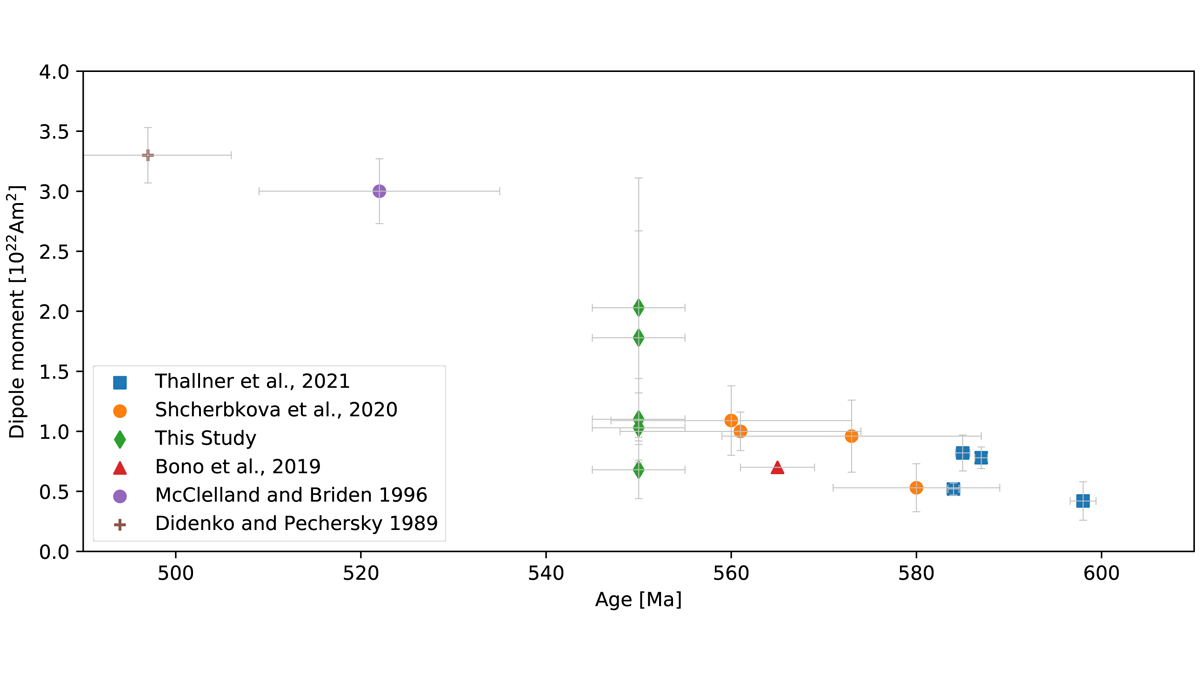
Plot showing a compilation the virtual dipole moment of the geomagnetic field during the Ediacaran and Cambrian periods.
Posted inEditors' Highlights

A Dipole Field from the Ediacaran-Cambrian Transition Onward?

by Mark J. Dekkers 14 October 202114 March 2023

The Ediacaran features an instable magnetic field complicating paleogeographic reconstructions; a new paleointensity study on late Ediacaran rocks indicates a weak but stable dipolar field.

Dense green pine trees form the foreground. Gray rocks forming low-relief hills are in the middle distance, dotted with green trees, with a hazy blue sky in the background.
Posted inResearch Spotlights

Extinct Style of Plate Tectonics Explains Early Earth’s Flat Mountains

by Rebecca Dzombak 7 October 202117 February 2023

The geologic record suggests that despite Earth’s hot, thin crust during the Proterozoic, mountains were still able to form thanks to an extinct style of crustal deformation.
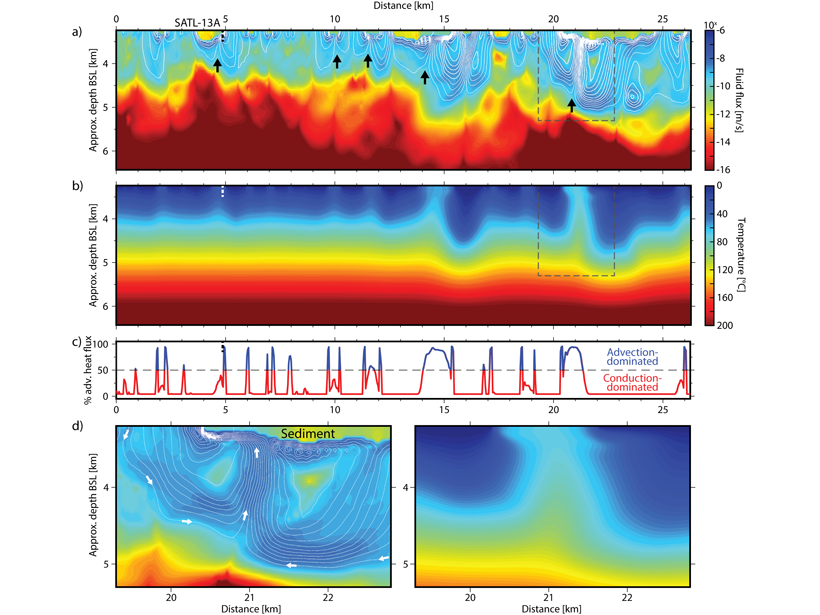
Several charts showing the results of hydrothermal flow modelling along a 26 km-long line located on 7-million-year-old Atlantic oceanic crust.
Posted inEditors' Highlights

Mechanisms of Hydrothermal Ocean Plate Cooling Revealed

by V. Sallarès 28 September 202127 January 2023

A combination of waveform tomography and hydrothermal modelling allows characterizing the mechanisms and reach of fluid flux and ocean plate cooling near mid-ocean ridges with unprecedented detail.

The Sun sets at Stonehenge
Posted inENGAGE, News

State-of-the-Art Technology, Serendipity, and Secrets of Stonehenge

Richard Sima, freelance science writer by Richard J. Sima 8 September 202129 March 2023

The first comprehensive analysis of what the sarsen stones are made of came about with new technology—and good old-fashioned luck.

Researchers collect sediments from a rocky stream with a helicopter and steep rock hills in the background
Posted inScience Updates

Earth’s Continents Share an Ancient Crustal Ancestor

by J. Hollis, C. Kirkland, M. Hartnady, M. Barham and A. Steenfelt 23 August 202122 February 2022

How did today’s continents come to be? Geological sleuths found clues in grains of sand.
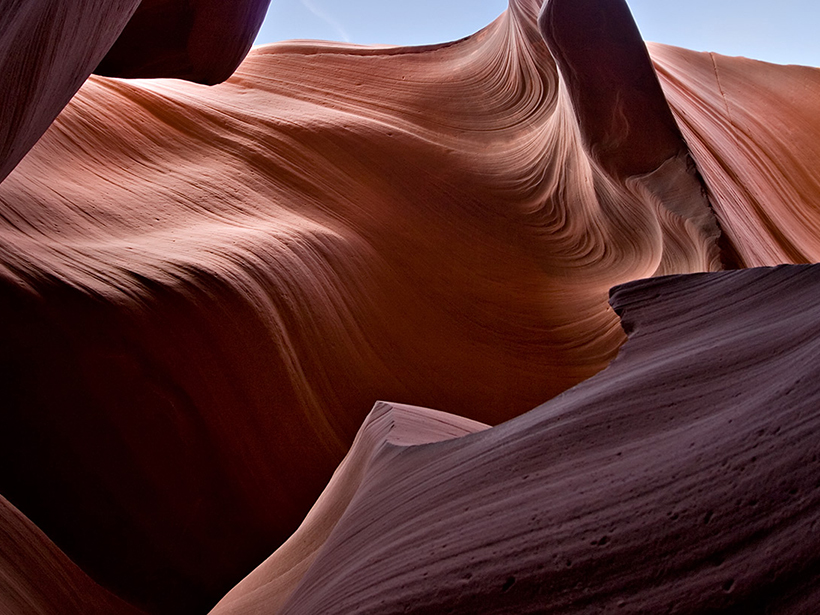
Viendo hacia afuera desde el Canion del Antílope Inferior, con el cielo cerca de la parte superior de la foto. La laminación característica de la arenisca es visible.
Posted inResearch Spotlights

La primera mirada de la meteorización a escala angstrom

Kate Wheeling, freelance science writer by Kate Wheeling 19 August 202124 February 2022

Investigadores observan cómo el vapor de agua y el líquido alteran las rocas sedimentarias a través de procesos físicos y químicos.

Map of Kentucky showing indoor radon potential
Posted inNews

Detailed Geologic Mapping Helps Identify Health Hazards

Sarah Derouin, Science Writer by Sarah Derouin 27 July 202113 October 2022

A team of geologists and nursing researchers created an interactive radon hazard map for Kentucky residents—and it was possible only because of the high-resolution bedrock mapping in the state.

In the center of a cross-polarized image, a purple-pink grain of muscovite with dark asymmetric kink bands lies within a matrix of much finer grained, rainbow-colored micas, as well as small black, white, and gray feldspar and quartz grains.
Posted inNews

Tiny Kinks Record Ancient Quakes

by Alka Tripathy-Lang 19 July 202114 September 2022

As Earth ruptures, micas kink. These kink bands hide in rocks millions of years old, preserving evidence of past quakes.

Two images comparing a high-resolution pore network in rock and a reconstruction of the same by the machine learning model.
Posted inEditors' Highlights

Reconstructing Rocks with Machine Learning

by D. O'Malley 12 July 20213 October 2022

Machine learning can be used to accurately reconstruct high-resolution, 3D images of rocks from 2D cross-sections, which opens the door to more detailed simulations.

A photo of Renato Funiciello in the Dolomites Mountains of the Alps in 2005.
Posted inEditors' Vox

Renato Funiciello, an Inspiration to Modern Geology in Italy

by M. Meghraoui 24 June 20219 November 2022

A special collection in Tectonics on geodynamics in the Mediterranean region celebrates the life and work of the renowned Italian geologist Renato Funiciello.

Posts pagination

Newer posts 1 … 10 11 12 13 14 … 28 Older posts
Over a dark blue-green square appear the words Special Report: The State of the Science 1 Year On.

Features from AGU Publications

Research Spotlights

How Does Social Vulnerability Evolve After a Tropical Cyclone?

4 August 20264 August 2026
Editors' Highlights

Late Campanian Arabia-Eastern Anatolia Collision

4 August 20264 August 2026
Editors' Vox

How Bubbles Reshape Air-Sea Gas Exchange

5 August 20265 August 2026
Eos logo at left; AGU logo at right

About Eos
ENGAGE
Awards
Contact

Advertise
Submit
Career Center
Sitemap

© 2026 American Geophysical Union. All rights reserved Powered by Newspack