• About
  • Special Reports
  • Topics
    • Climate
    • Earth Science
    • Oceans
    • Space & Planets
    • Health & Ecosystems
    • Culture & Policy
    • Education & Careers
    • Opinions
  • Projects
    • Postcards From the Field
    • ENGAGE
    • Editors’ Highlights
    • Editors’ Vox
    • Eos en Español
    • Eos 简体中文版
    • Print Archive: 2015–2025
  • Policy Tracker
  • Blogs
    • Research & Developments
    • The Landslide Blog
  • Newsletter
  • Submit to Eos
  • AGU.org
  • Career Center
  • Join AGU
  • Give to AGU
  • About
  • Special Reports
  • Topics
    • Climate
    • Earth Science
    • Oceans
    • Space & Planets
    • Health & Ecosystems
    • Culture & Policy
    • Education & Careers
    • Opinions
  • Projects
    • Postcards From the Field
    • ENGAGE
    • Editors’ Highlights
    • Editors’ Vox
    • Eos en Español
    • Eos 简体中文版
    • Print Archive: 2015–2025
  • Policy Tracker
  • Blogs
    • Research & Developments
    • The Landslide Blog
  • Newsletter
  • Submit to Eos
Skip to content
  • AGU.org
  • Career Center
  • Join AGU
  • Give to AGU
Eos

Eos

Science News by AGU

Support Eos
Sign Up for Newsletter
  • About
  • Special Reports
  • Topics
    • Climate
    • Earth Science
    • Oceans
    • Space & Planets
    • Health & Ecosystems
    • Culture & Policy
    • Education & Careers
    • Opinions
  • Projects
    • Postcards From the Field
    • ENGAGE
    • Editors’ Highlights
    • Editors’ Vox
    • Eos en Español
    • Eos 简体中文版
    • Print Archive: 2015–2025
  • Policy Tracker
  • Blogs
    • Research & Developments
    • The Landslide Blog
  • Newsletter
  • Submit to Eos

mountains

seismic-activity-interaction-radio-waves-surface-plasmons
Posted inResearch Spotlights

Earthquakes Could Funnel Radio Waves to Dark Zones in Mountains

Leah Crane by L. Crane 29 September 20167 October 2021

By being coupled with a layer of mobile electrical charges on the Earth's surface, radio waves could travel over the ground to areas that would normally be unreachable, like behind a mountain.

aoraki-mount-cook-new-zealand-alpine-fault
Posted inResearch Spotlights

Revising the Displacement History of New Zealand's Alpine Fault

by Terri Cook 22 July 201624 March 2023

A reinterpretation of structural and paleomagnetic data suggests that New Zealand's Alpine Fault accommodates a far greater percentage of geologically recent plate motion than previously thought.
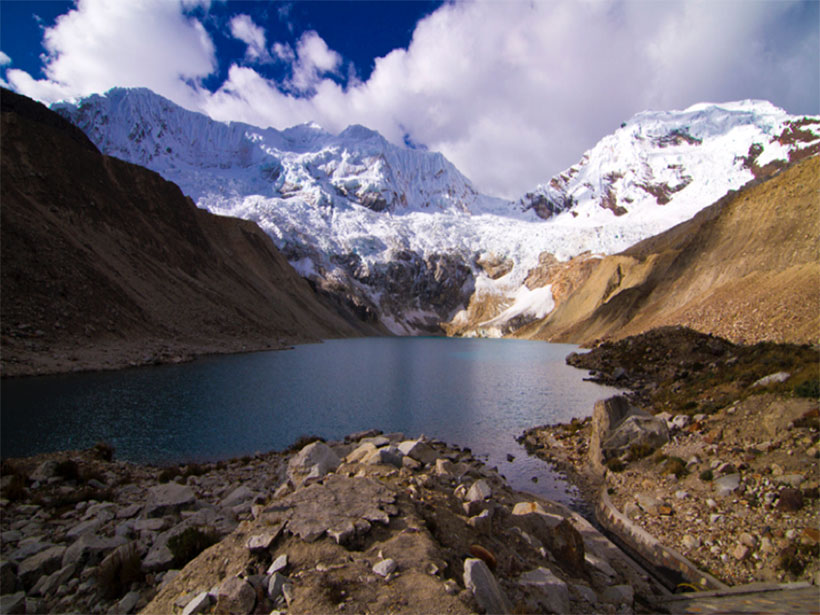
Lake Palcacocha, which flooded the city of Huaraz, Peru, in 1941.
Posted inNews

Focusing the Human Lens on Glacial Outburst Floods

JoAnna Wendel, freelance science writer and illustrator by JoAnna Wendel 17 June 201617 March 2023

To better prepare mountain communities for possible floods, experts say that it is important to understand the communities themselves.

The Pamir Mountains, known as “the Roof of the World,” which tower as high as 7495 meters.
Posted inAGU News

Villages Must Recalibrate Time to Survive in the Pamir Mountains

by B. Y. Landis 13 April 20167 October 2021

Scientists plan projects this year to help a rugged, troubled region of central Asia retune traditional timekeeping methods based on environmental cues in the face of climate change.

Posted inResearch Spotlights

Modeling Weather over Mountainous Terrain

Kate Wheeling, freelance science writer by Kate Wheeling 25 February 20162 August 2022

Scientists use high-resolution models to study how the jagged terrain of the Earth's mountains influences precipitation.

Posted inNews

Climate Change Freezes Mountain Wildflower Reproduction

Cody Sullivan by C. Sullivan 22 February 20164 November 2022

New research provides evidence that plants that flower earlier in the year because of climate warming experience more frost damage and have less reproductive success.

Posted inResearch Spotlights

Improved Models of Wind Flow over Mountains

by Terri Cook 15 February 20167 October 2021

A new approach for representing areas of low-lying mountains improves the simulation of atmospheric flow over gentle topography without increasing computational requirements.

Posted inResearch Spotlights

Massive Carbon Dioxide Stores Beneath Mammoth Mountain

Sarah Stanley, Science Writer by Sarah Stanley 2 February 201611 May 2022

Gas in rocky pores beneath the surface of California's Mammoth Mountain could fuel dangerous carbon dioxide emissions for the next 28 to 1100 years.

Posted inScience Updates

Addressing Challenges of Mitigating Flood Risk in Mountain Areas

by D. Tullos and S. K. Jain 8 June 20156 February 2023

Workshop on Modeling and Managing Flood Risk in Mountainous Areas; Folsom, California, 17–19 February 2015

Posted inResearch Spotlights

New Insights into the Formation of Old Norwegian Mountains

by S. Palus 8 May 20152 March 2023

Researchers look to minerals in rocks from Norway's Western Gneiss Region to determine when the mountain-making period came to a close in the region.

Posts pagination

Newer posts 1 … 9 10 11 12 Older posts
Over a dark blue-green square appear the words Special Report: The State of the Science 1 Year On.

Features from AGU Publications

Research Spotlights

Rivers in the Antarctic Sky, Captured in 3D

2 June 20262 June 2026
Editors' Highlights

Pre-Existing Structure and Stress Shape Geothermal-Induced Seismicity

2 June 20261 June 2026
Editors' Vox

Small-Scale Indian Ocean Dynamics Underpin Marine Ecology and Climate

4 June 20263 June 2026
Eos logo at left; AGU logo at right

About Eos
ENGAGE
Awards
Contact

Advertise
Submit
Career Center
Sitemap

© 2026 American Geophysical Union. All rights reserved Powered by Newspack