

When the first salmon return to Oregon’s Coquille River in the spring, thousands of fish congregate, and an important ceremony for the Coquille Indian Tribe (CIT) unfolds.
“You come out and you welcome them,” said Jason Younker, former Coquille Indian Tribe chief and assistant vice president of sovereign government-to-government relations at the University of Oregon. Neighbors share the first salmon of the season, and fish bones are returned to the river. “We’re giving thanks. And if you give thanks regularly and with intent, then you’re less likely to abuse the resources that are there in front of you,” said Younker.
But the region’s salmon have not always been treated with such care. The CIT is intimately familiar with the history of both the Coquille River and the Coos Bay estuary, located roughly 24 kilometers (15 miles) to the north. In the 1800s, logging practices and grazing animals introduced by settlers wreaked havoc on the salmon population in the estuary. These historical accounts are backed by recent research from the University of Oregon conducted in collaboration with CIT members, which was presented on 16 December at AGU’s Annual Meeting 2025 in New Orleans.
The research began when scientists studying the area’s vegetation were discussing plants and fish over dinner with Younker. During the conversation, Younker shared the importance of salmon to the region and to settlement history. Tribal knowledge pointed to the idea that salmon do not merely pass through Coos Bay but also deliver nutrients such as nitrogen from the ocean to rivers and wetlands.
“The bells in my head started ringing,” said Katya Podkovyroff, a doctoral student studying biogeochemistry and paleoecology at the University of Oregon. “If I’m looking at vegetation, salmon periods of migration at different points in time would impact the plant communities.”
Of Salmon and Soil
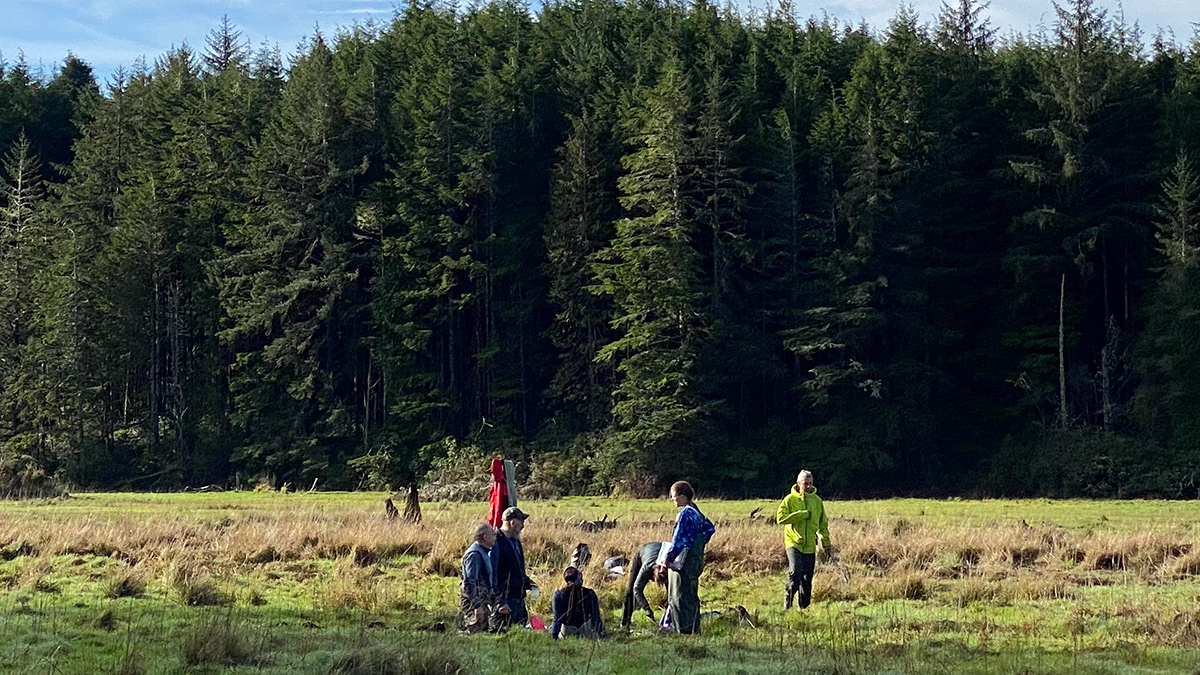
University of Oregon researchers teamed up with CIT members, including university faculty members Younker and Ashley Cordes, a professor of Indigenous media studies. Together the group proposed that the rapid decline in salmon had removed nutrients from the river that supported plants and other animals.
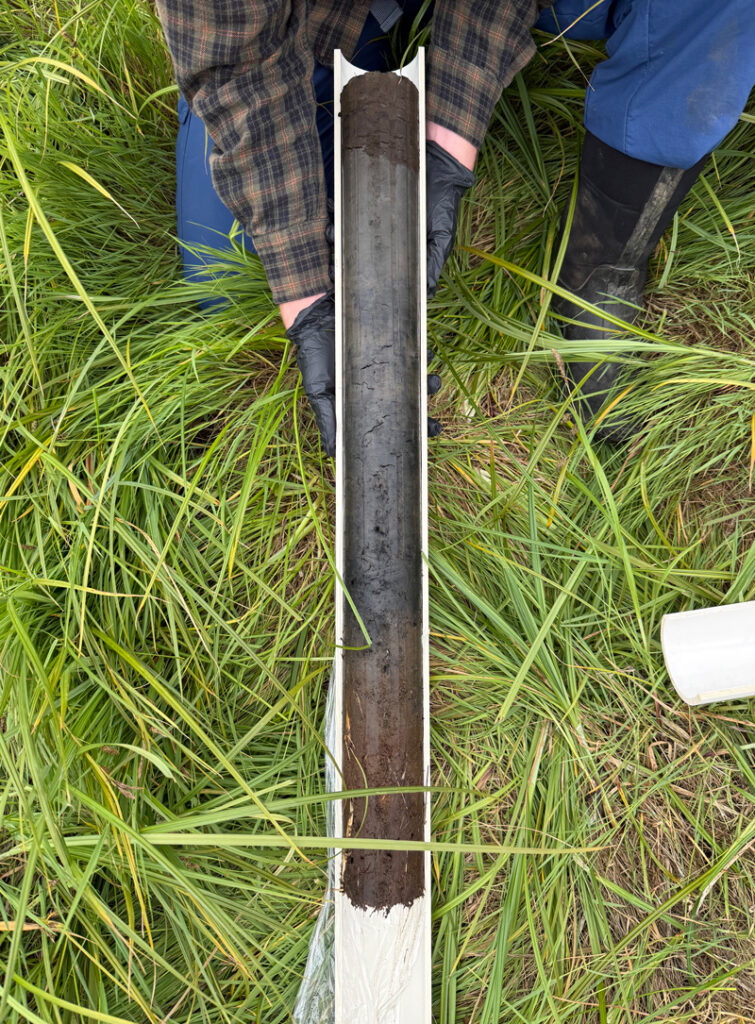
To test their hypothesis, the researchers extracted meter-long soil cores from dry ground near the waters of the estuary, providing a physical timeline of the land, with the oldest soil at the bottom and newest soil at the top. They looked at elemental indicators, such as carbon-to-nitrogen ratios, to understand how available nutrients fluctuated over time.
Preliminary results showed that sites with previous restoration efforts—such as the removal of dikes and the addition of trees to stabilize stream banks—had lower carbon-to-nitrogen ratios and higher nitrogen-15 levels, aligning with those found in areas with more salmon. The patterns indicated that when salmon were more abundant, they likely played a critical role in the river’s nutrient cycling.
“I think that when we talk about science, you have to talk about Indigenous science, Indigenous ways of knowing, too.”
There are limitations to using cores to learn about an area. Most notably, a soil core represents only one very specific spot and is unable to show how its chemical or biological contents arrived at that location. To help address this limitation, the researchers plan to conduct more testing of regional environmental DNA, which could provide further evidence of when and where salmon have lived in the area.
“That seems like a really interesting and unique way of using this kind of tool, to try to look back through time, through cores,” said Katharyn Boyer, a restoration ecologist at San Francisco State University who was not involved in the research.
The team hopes their work will inform future restoration efforts. Regardless of the outcome, though, the research will remain collaborative. “I think that when we talk about science, you have to talk about Indigenous science, Indigenous ways of knowing, too. They, too, can augment science,” said Younker. “I think that Indigenous ways of knowing complement a lot of the science that exists.”
—Stella Mayerhoff (@stellamayerhoff.bsky.social), Science Writer