
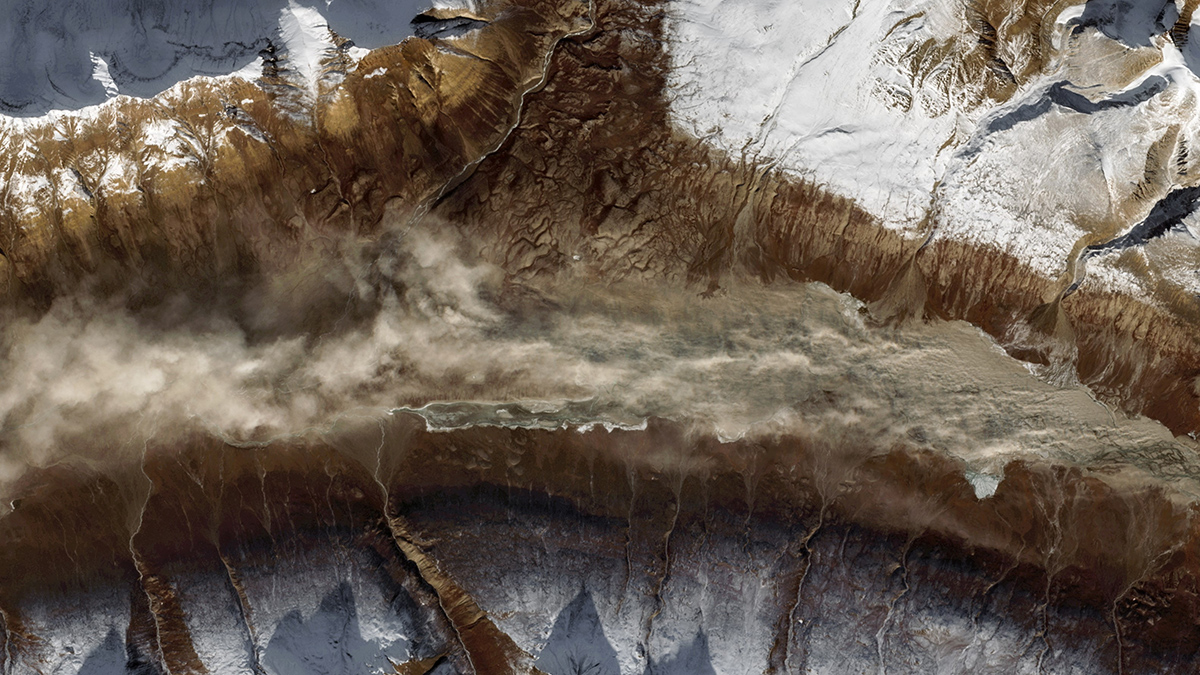
In the summers of 2016 and 2017, a small research team endured harsh conditions on the Greenland Ice Sheet to gather data about the aerosols above it. These tiny particles carry crucial information about the elements that contribute to glacial ice loss, making them invaluable in the fight against climate change.
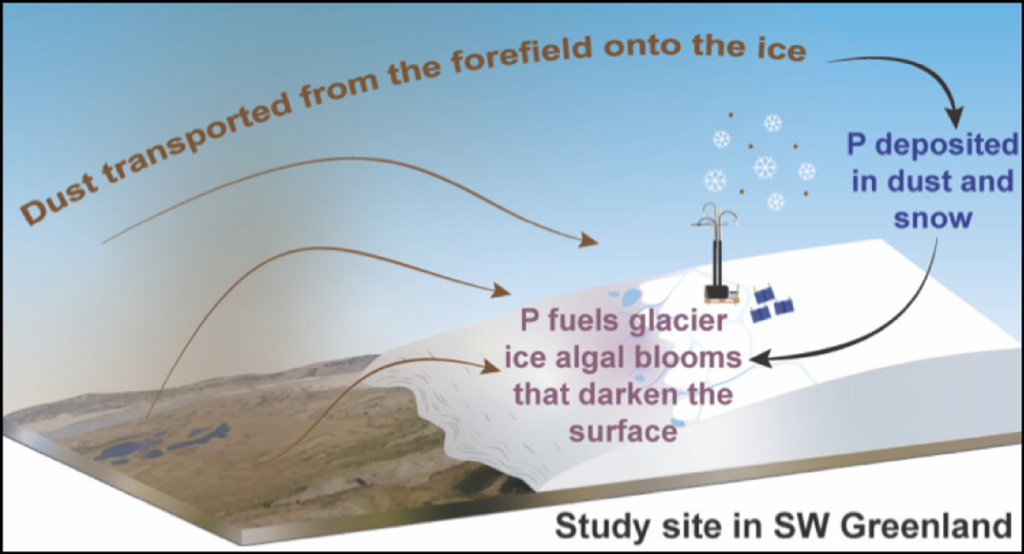
In a new study published in Environmental Science and Technology, this team reported that aerosols contain significant amounts of mineral dust, which can feed phosphorus to hungry, ice-melting algae.
“This study’s findings are important,” said Jasper Kok, an atmospheric physicist at the University of California, Los Angeles, who was not involved with the research. “The Arctic is warming several times faster than the global average,” he explained, and this warming exposes more bare soils that will only increase dust emissions.
Dusty Fieldwork
Prior research found that mineral dust contains significant quantities of phosphorus, a key growth factor for many species of dark-colored algae. Because dark-colored algae infiltrate snow and glaciers, decreasing their albedo and forcing them to absorb more sunshine, understanding the mechanics of dust delivery is imperative for accurately measuring glacial melt and estimating the impact of ongoing climate change.
“Most climate models omit this high-latitude dust,” said Kok.
To better understand how mineral dust affects the Greenland Ice Sheet, researchers captured aerosols and took measurements from ice cores and snow samples at a location north of Kangerlussuaq in southwest Greenland.
“To my knowledge, this is the first study to conduct real-time aerosol measurements on the Greenland Ice Sheet and connect those results to the algal blooms forming on the ice.”
“We were in a tent camp approximately 35 to 100 kilometers into the Greenland Ice Sheet,” said Liane Benning, a biogeochemist at the GFZ Helmholtz Centre for Geosciences in Germany and coauthor of the study. “We were there for up to 5 to 6 weeks to get these samples.”
The collected materials enabled the researchers to scrutinize dust above and within the glacier, which would, in turn, allow them to determine the dust’s origin, composition, and how many algae it could feed.
Scanning electron microscopes revealed the aerosols were primarily composed of mineral dust from the southern end of the Greenland Ice Sheet, which aligns with past research showing that area is a great producer of dust emissions. The quantity within the aerosols suggests the dust contains enough phosphorus to fuel massive algal blooms within the ice sheet.
“To my knowledge this is the first study to conduct real-time aerosol measurements on the Greenland Ice Sheet and connect those results to the algal blooms forming on the ice,” said Jenine McCutcheon, a geomicrobiologist at the University of Waterloo in Canada and lead author of the study. “Local Greenlandic locations near the coast are the most likely source, which matches our geochemical analyses.”
Microbes on the Move
But the results also revealed something else. In addition to mineral dust, the aerosols contained soot, fungi, and different species of algae specialized to living in ice and snow. The researchers detected one species of glacial ice algae, Ancylonema nordenskioeldii, that is well-known to reduce glacial albedo and increase melting.
The study suggests ice-melting microbes may be blown across the ice sheet, allowing them to penetrate areas previously unexposed to microbes. “These organisms can be picked up by wind,” explained McCutcheon, “which may provide a means for these algae to be transported to new locations on the ice.”
Because other high-latitude environments are similarly pilloried by nutrient-rich dust, the study has wider implications for the Arctic, said Kok. “This study underscores the need to include this dust for more accurate predictions of how the Greenland Ice Sheet, and the Arctic more broadly, will evolve in the future.”
McCutcheon agreed. “While these results won’t stop ice mass loss, they will help us better understand how melting will progress in the future,” she said.
—Taylor Mitchell Brown (@tmitchellbrown.bsky.social), Science Writer