
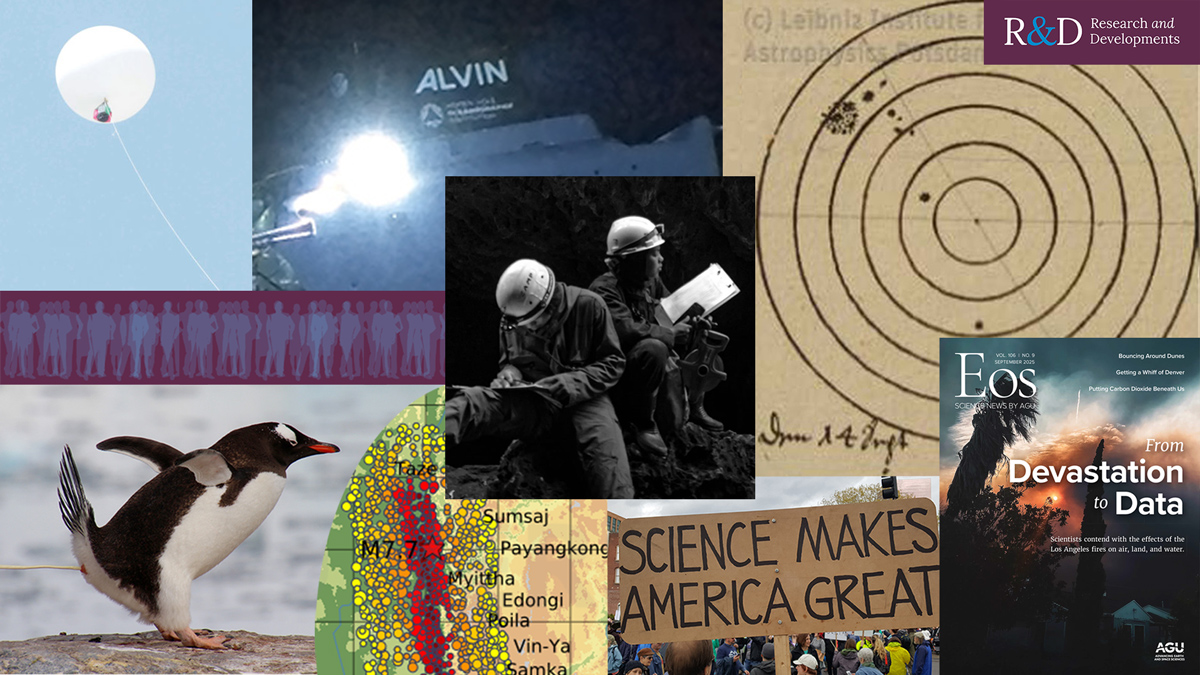
It’s been a trying year for science and scientists, and I’m proud of the way Eos is meeting the moment with a new blog, Research & Developments (R&D), dedicated to quickly relaying content and context for science news. Anchoring R&D coverage is our Science Policy Tracker, updated multiple times a day with late-breaking stories from around the world. Bookmark it!
—Caryl-Sue Micalizio, Editor in Chief
Crowds Stand Up for Science Across the United States. In March, Eos reporters and editors documented huge Stand Up for Science rallies across the country. The resulting story conveys the inspiring passion, anger, hope, and resilience of scientists who faced monumental challenges this year.
—Grace van Deelen, Staff Writer
I struggled to narrow down my favorite science stories of 2025, but there were two standouts. The first is an Eos article written by Katherine Bourzac about air pollution, environmental racism, and the difficulties that come with measuring and regulating odors. The second is a short documentary from The New York Times featuring unbelievably crisp audio of a melting glacier. I also enjoyed these two articles about health risks associated with access to air-conditioning and climate doulas.
—Anaise Aristide, Senior Production and Analytics Specialist
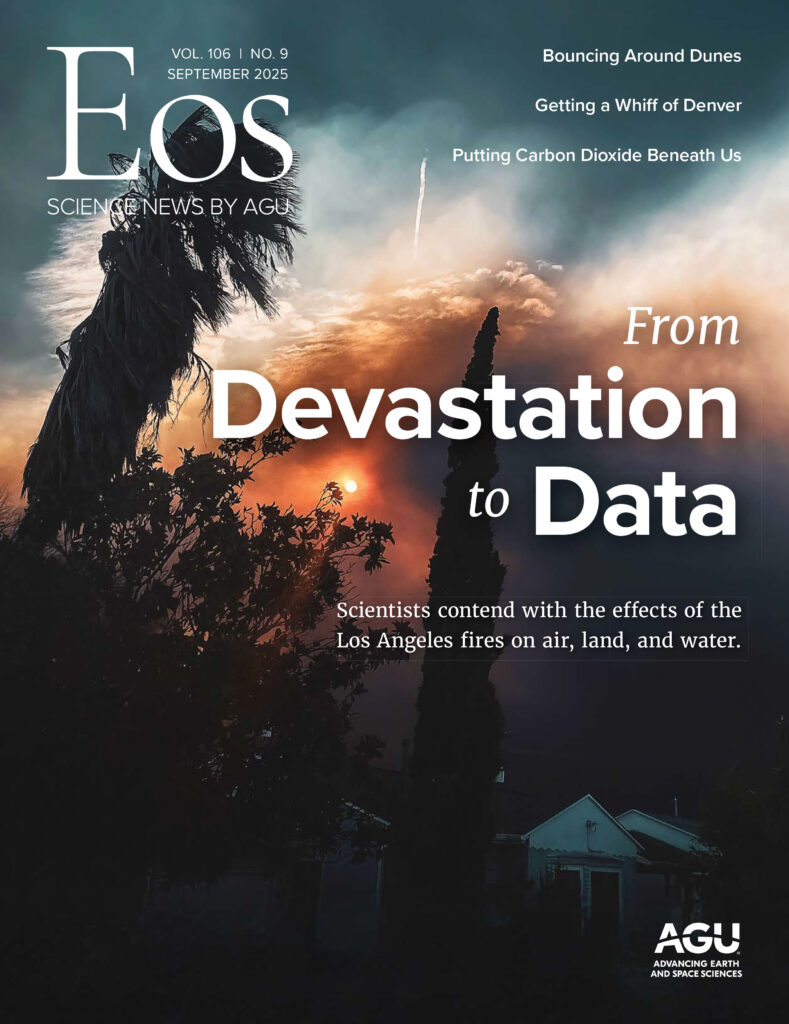
This year started out with two devastating fires that swept through the L.A. area, displacing thousands of people and causing millions of dollars in damage. The area is home to scientists of all disciplines, many of whom sprang into action to understand the impacts of the fires even as themselves and their families were affected. Eos spoke with these scientists about the fires’ impact on air, land, sea, and the people in a four-part series, highlighting the strength and resilience of the science community in the face of disaster.
—Kimberly M. S. Cartier, Senior Science Reporter
When Disaster Science Strikes Close to Home. Amid Eos’s team coverage of science done in the aftermath of the January 2025 Los Angeles fire, I was inspired by Kimberley Cartier’s coverage of the local scientists who jumped in to lend a hand with data collection. The work these researchers did must’ve had physical and emotional tolls—and understandably, it wasn’t always appreciated in the moment by residents who’d just lost their homes—but it was an important supplement to agency efforts to document the fires’ myriad effects on public and environmental health and to communicate those effects to local communities.
—Timothy Oleson, Senior Science Editor
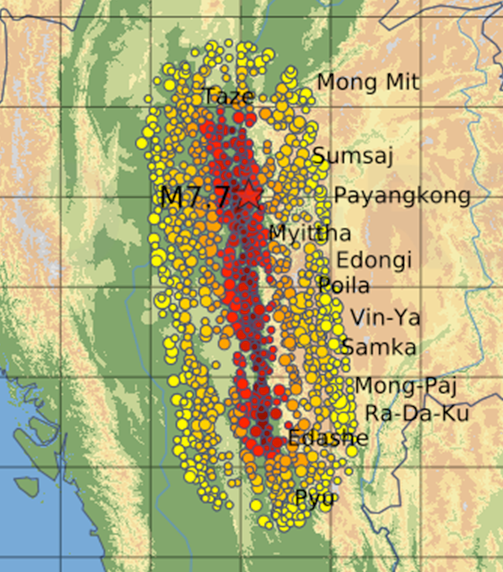
Video Shows Pulsing and Curving Fault Behavior. This article wins 2025 for its sheer coolness. By pure chance, a security camera captured video of the Myanmar earthquake (which I may have replayed more than a dozen times). This visually confirmed the curvature of fault slip and that earthquakes propagate in pulses. The story includes a word that was new to me—always a plus: slickenline. The scientists’ analysis of the video showed that these scratch marks relate to the direction an earthquake traveled, with implications for future hazards if an earthquake tends to rupture in one direction.
—Faith Ishii, Assistant Director, Operations
33.8 Million People in the United States Live on Sinking Land. This article by our colleague Grace van Deelen was both fascinating and dismaying. I mean, most of us knew that New Orleans and Venice were sinking. But New York is sinking! Denver is sinking! Houston is sinking! Because much of this subsidence is linked to human activities like infrastructure building and groundwater pumping, Grace’s coverage is an important way to raise awareness of this issue and of what can be done about it.
—Emily Gardner, Associate Editor
A Major Miner Problem. A difficult conundrum faces part of the geophysics workforce. As the realities of climate change have led to scientists withdrawing from the mining industry, it turns out we need experts in this field more than ever if we are to find the critical minerals for renewable energy in a way that can meaningfully supplant our reliance on oil and gas.
—Heather Goss, Publisher and Senior Director of Strategic Communications and Marketing
Sunspot Drawings Illuminate 400 Years of Solar Activity. I found the project to combine centuries-old data with modern technology for the benefit of present-day researchers fascinating, and I loved that historians were given credit as “detectives” and “real heroes” who “went from archives to basements and traveled all over the world and talked with people, convinced them to let them in, allowed them to take pictures.”
—Tshawna Byerly, Copy Editor
Scientists Discover an Ancient Landscape – in Our Own Backyard. I loved learning about the identification of ancient grasslands and meadow in Virginia.
—Lexi Shultz, Vice President of Science Policy & Government Relations
An Upgraded Alvin Puts New Ocean Depths Within Reach. The mysteries and oddities of the deep ocean are a never-ending source of amazement to me. So I loved learning about how the upgraded capabilities of the long-serving and extraordinarily productive Alvin submersible now put roughly 99% of the seafloor within scientists’ reach.
—Timothy Oleson, Senior Science Editor
The Doomsday Glacier Is Getting Closer and Closer to Irreversible Collapse. Our collective attention continues to zero in on the Thwaites Glacier. A new feature story in Wired covers research in JGR Earth Surface on the 20-year evolution of fractures near the glacier’s “pinning point” keeping it anchored to the West Antarctic Ice Sheet. Eos has long covered research on this important climate signal, nicknamed the “Doomsday Glacier,” including the National Science Foundation’s decision earlier this year to decommission the Nathaniel B. Palmer, the United States’ only Antarctic research vessel–icebreaker.
—Heather Goss, Publisher and Senior Director of Strategic Communications and Marketing
What If Our Ancestors Didn’t Feel Anything Like We Do? This is a feature in The Atlantic about a field that blends history, psychology, and neuroscience to try to determine whether emotions—like anger or disgust or love—actually felt the same to our ancestors. It’s a fascinating idea that’s well worth the read.
—Grace van Deelen, Staff Writer
The Truth About Testosterone. The Science Writers Association of the Rocky Mountains launched its inaugural science writing awards this year. I enjoyed this piece by Stephanie Pappas for Scientific American, which received an honorable mention. Deep, scientific dives into the health trends hawked by TikTokers and podcasters are almost always important, and I found this account particularly engrossing.
—Emily Gardner, Associate Editor
Small Satellites, Big Futures. This feature by Eos senior science reporter Kim Cartier spotlights several programs in which high school and college students can gain hands-on experience designing, building, and launching cubesats. Full of great quotations and photos, this article about encouraging and building up the next generation was a bright spot in a year full of bad news about science funding and programs.
— Faith Ishii, Assistant Director, Operations
Awesome turnout in support of @ncar-ucar.bsky.social at #AGU25. Take a look at how many people use our products!
— Sam Rabin (@samsrabin.bsky.social) December 18, 2025 at 2:35 PM
[image or embed]
It was gratifying to see virtually the entire scientific community rally behind the National Center for Atmospheric Research, much of it documented in the #SaveNCAR tag. Sometimes it’s easy to forget we’re all in this together, but we are.
—Caryl-Sue Micalizio, Editor in Chief

Because it is fun, I am going to include The Batman Effect: “In the control condition, a female experimenter, appearing pregnant, boarded the train with an observer. In the experimental condition, an additional experimenter dressed as Batman entered from another door. Passengers were significantly more likely to offer their seat when Batman was present (67.21% vs. 37.66%, OR = 3.393, p < 0.001). Notably, 44% of those who offered their seat in the experimental condition reported not seeing Batman. These findings suggest that unexpected events can promote prosociality, even without conscious awareness, with implications for encouraging kindness in public settings.” Science!
—Liz Crocker, Director, Thriving Earth Exchange
Penguin poop!
—Joshua Weinberg, Vice President, Strategic Communications and Marketing
—AGU