Research & Developments is a blog for brief updates that provide context for the flurry of news that impacts science and scientists today.
The key word here is could. Experts including Ken Graham, the director of NOAA’s National Weather Service, all emphasize that no two El Niños are alike.
“Each one is unique with its own imprint on our weather,” Graham said in a NOAA press release. However, scientists have learned a few things from watching the ways that this warm phase of a natural climate cycle over the tropical Pacific has affected our weather patterns in the past.
“Advanced monitoring and an improved understanding of El Niño patterns allow the NWS to better predict and better prepare the public and our core partners for what is to come,” Graham said.
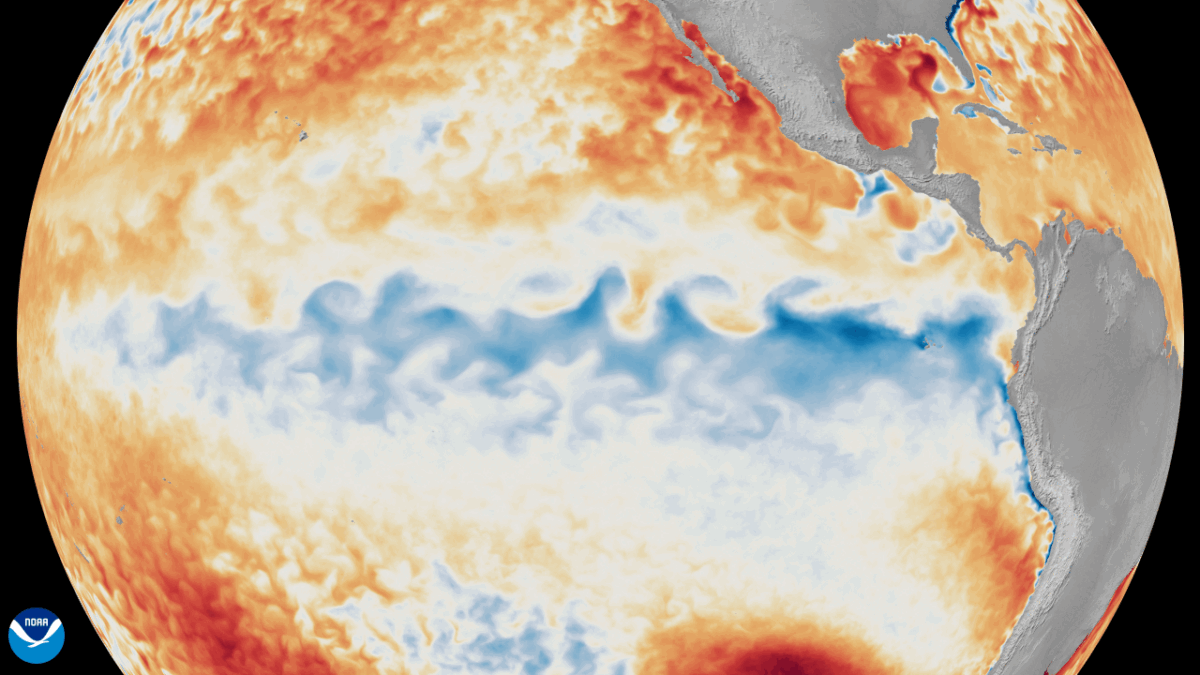
This morning, NOAA released an El Niño Advisory, announcing that the climate phenomenon (the warm phase of the El Niño–Southern Oscillation) has officially arrived in the tropical Pacific. The agency forecasts a 63% chance of a “very strong” El Niño from November 2026 to January 2027 that “would rank among the largest El Niño events in the historical record.”
NOAA defines a “very strong” El Niño as when the Pacific’s surface waters are more than 2°C warmer than average. The agency doesn’t use the phrase “Super El Niño,” but there have only been three such “super” or “very strong” El Niño events since 1980. The last one was in 2015.
What does this mean for climate, for humans, and marine species? Here’s a roundup of some potential forecasted effects—some good, some bad—of the weather pattern that’s been making headlines over the past few months.
1. More rain and snow in the southern U.S.
In a typical year, a warm pool of water in the equatorial Pacific would be transported westward—away from the western coast of the Americas—by trade winds. But during an El Niño event, those trade winds weaken, and the warm pool of water extends east, explained Ariel Cohen, the meteorologist in charge of the National Weather Service’s Los Angeles and Oxnard Office in a press briefing at the Aquarium of the Pacific in Long Beach, Calif.
This warm water “causes jet energy in the atmosphere to bring disturbed weather southward across the southern United States, which can bring wetter than normal conditions to our area with drier conditions farther to the north,” Cohen said.
The southward shift of the storm track could also lead to drier conditions over the northern Rockies and as far east as the Ohio and Tennessee Valleys.
2. More shark and whale sightings off the Southern California coast
In the past, strong El Niños have led to decreased amounts of plankton in the Pacific, particularly the open ocean, forcing species that rely on plankton (and the species that rely on the species that rely on plankton, and so forth) to widen their net when searching for food.
“[Plankton] is important because that’s the base of the food web,” explained Andrew Leising, a research oceanographer at NOAA, at the Aquarium of the Pacific. “Marine mammals and other migratory species end up being closer to shore, because they’re going to where their food is.”
Whales in particular rely on the upwelling of cold water to bring them krill to eat. As they are driven nearer to the coast in search of food, they also grow more likely to become entangled in fishing nets.
3. A milder Atlantic hurricane season
Warm water is a key ingredient in a hurricane, so it might seem, at first thought, that the Pacific’s unusually warm waters might augur a more extreme hurricane season. But another effect of El Niño is that it strengthens vertical wind shear over the Atlantic. When winds are too strong, they can tear a storm apart before it picks up the momentum to become a hurricane.
“Wind shear is good for us, bad for the hurricanes,” Phil Klotzbach, a hurricane forecaster at Colorado State University and lead author of the university’s 2026 Atlantic Hurricane Forecast, told Eos.
NOAA’s 2026 Atlantic Hurricane Forecast suggests that the 2026 season has a 55% chance of being below normal, and will likely include 8 to 14 named storms with winds of at least 39 miles per hour.
4. Fewer squid along the California coast
Past El Niño events have shown that warmer Pacific waters can increase the likelihood of harmful algal blooms. Among other effects, these blooms can lead to a lower abundance, and a northward shift, of market squid. Market squid and Dungeness crab bring the most volume and value to California’s commercial fisheries.
In 2014, a large mass of hot water in the Pacific known as the Blob was followed up by an El Niño event. That year, “we had several closures of crab and shellfish fisheries due to harmful algal blooms,” Leising said.
However, Leising also explained that the warm patch of water in the Pacific this year is much smaller and farther from shore than the Blob was in 2014. So, though we may see effect similar those in 2014, they’re likely to be less extreme.
In addition, the same conditions driving sharks and whales toward the coast could also drive tuna toward the coast, leading to increased opportunities for that fishery.
5. More high-tide flooding on U.S. coasts
With El Niño shifting the Pacific jet stream south of its usual position, sea levels along the U.S. West Coast may rise, exacerbating the existing sea level rise linked to climate change. On the East Coast, the jet stream shift can lead to more storm surges, which combine with higher-than-typical precipitation levels.
“It usually ends up being a double whammy,” said NOAA oceanographer and high tide flooding expert William Sweet, in a NOAA news story. “The first punch is decades of sea level rise, which has waters close to the brim in many coastal communities. And now with this second punch—a strong El Niño—coastal communities face more frequent, deeper and widespread high tide flooding along both the West and East Coasts.”
6. A bad year for sea lions
El Niño events can have harmful effects on sea lions. Algal blooms can lead to severe illness, or even death, for the pinnipeds. Algal blooms can also kill off fish and cephalopod species (such as market squid) that sea lions rely on for food. During past El Niño events, California sea lions have also experienced lower rates of reproduction and produced smaller pups, Leising said.
“California sea lions are indicator species, meaning they will be one of the first species which may show signs of domoic acid toxicity, respond to changes in their ecosystem, and signal to the public how our oceans and ecosystem are doing,” said Brett Long, vice president of animal care at the Aquarium of the Pacific.
—Emily Gardner (@emfurd.bsky.social), Associate Editor
These updates are made possible through information from the scientific community. Do you have a story about science or scientists? Send us a tip at [email protected].