

Roughly half a century ago, the burgeoning field of marine cartography revealed a curious sight: Mid-ocean ridges punctuate the seafloor, their geographic highs running over our planet like the seams on a baseball. These features mark where Earth’s tectonic plates are diverging and magma is upwelling.
Researchers sent a remotely operated vehicle (ROV) to a mid-ocean ridge system deep in the Norwegian Sea and discovered unusually high levels of molecular hydrogen dissolved in the hydrothermal fluids there. That hydrogen, which can help fuel microbial activity, is likely arising from the degradation of organic matter, the team concluded. These results were published in Communications Earth and Environment.
Pulling Apart
Many of our planet’s mountain ranges are built by the convergence of tectonic plates. But there are also regions on Earth where tectonic plates are diverging. In those places, magma from the planet’s interior is rising toward the surface. Many of those so-called spreading sites happen to be located in ocean basins, and the result is a mid-ocean ridge: a range of underwater volcanoes.
Thanks to their volcanic origin and underwater locales, mid-ocean ridges are characterized by a chemically potent amalgam of seawater, seafloor sediments, and magmatic material. But relatively few mid-ocean ridge systems have been explored in detail, partly because many lie beneath thousands of meters of water. “There’s still much more to learn about these systems,” said Alexander Diehl, a geochemist at MARUM – Center for Marine Environmental Sciences at the University of Bremen in Germany.
In 2022, a team led by MARUM researchers studied the Knipovich Ridge system off the coast of Svalbard. This mid-ocean ridge is known for being particularly slow spreading—its tectonic plates are diverging at only about 14 millimeters per year. (Fingernails grow about twice as fast.) Slow-spreading sites tend to get less research attention than fast-spreading sites, said Diehl. The reason is the latter tend to have larger supplies of upwelling magma and therefore more hydrothermal venting, he explained.
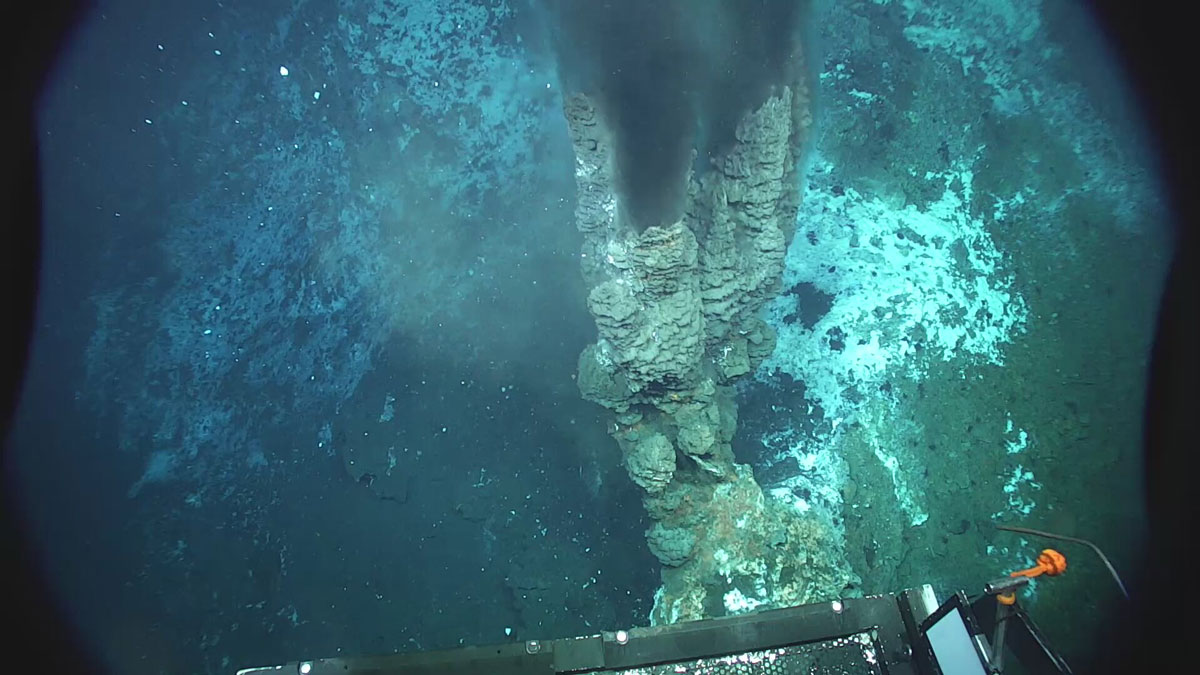
The 2022 cruise aboard the R/V Maria S. Merian revealed previously unknown fluid escape sites—including iconic black smokers—and an array of microbes that thrived in the utter absence of sunlight. Researchers used an ROV to collect hydrothermal fluids emanating from four vent sites along the Knipovich Ridge. Unfortunately, however, the sampling devices aboard the vehicle were not gas tight, and some of the dissolved gases escaped. “The concentrations of volatiles were not quantified correctly,” said Diehl.
A Second Chance
“They maintain pressure inside the sampler not only during recovery but also in the laboratory.”
But 2 years later, scientists got a second chance to visit the Knipovich Ridge. Diehl was one of the researchers who joined a 2024 cruise, again aboard R/V Maria S. Merian, to revisit the slow-spreading site. This time, the team brought gas-tight devices known as isobaric fluid samplers. “They maintain pressure inside the sampler not only during recovery but also in the laboratory,” said Diehl.
Diehl and his colleagues collected 160-milliliter samples of hydrothermal fluids from several vent sites on the Knipovich Ridge at a depth of roughly 3,000 meters. The team then analyzed the samples on board the R/V Maria S. Merian. The team recorded high levels of silica, alkaline pH levels, and low concentrations of metals like iron and manganese consistent with other hydrothermal systems where fluids circulate through sediments. But to their surprise they also noted unusually high levels of molecular hydrogen. There was more than twice the highest amount that had ever been recorded in any sediment-hosted hydrothermal vent.
Hydrogen is important to many life-forms in the deep ocean that don’t receive sunlight, said Jeff Seewald, a geochemist at the Woods Hole Oceanographic Institution in Woods Hole, Mass., not involved in the research. “A lot of organisms can use it.” (Seewald developed the concept for the isobaric fluid samplers that Diehl and his colleagues used on their 2024 cruise.)
A Double Whammy
Finding so much hydrogen on the Knipovich Ridge baffled Diehl and his team. High concentrations of hydrogen typically arise in hydrothermal systems dominated by ultramafic rocks from the mantle, whereas the vents that Diehl and his colleagues studied were surrounded by terrestrial sediments sloughed off from the fjords of Svalbard.
Diehl and his team ran computer simulations and found that the high concentrations of molecular hydrogen could be explained by terrestrial sediments. The culprit, the researchers concluded, was the degradation of organic matter entrained in those sediments. Those reactions likely played a role in producing much of the hydrogen the team measured.
“You could potentially generate a significant amount of hydrogen, which could then be utilized by microbes.”
The hydrothermal system on the Knipovich Ridge is a powerhouse of hydrogen production, Seewald said. Finding similar systems on ocean worlds could have implications for life beyond Earth, he added. “You could potentially generate a significant amount of hydrogen, which could then be utilized by microbes.”
In the future, Diehl hopes to join another cruise to return to the Knipovich Ridge. It’s a fascinating site to visit, even if only vicariously, he said. “It’s a lot of fun to sit behind the pilots of the ROV.”
—Katherine Kornei (@KatherineKornei), Science Writer