
Ionic Compounds: Worth Their Salt?
Salt of the Earth: Vast Underground Salt Caverns Are Preserving Our History—and Just Might Power Our Future
How the Rise of a Salty Blob Led to the Fall of the Last Ice Age
Insights for Making Quick Clay Landslides Less Quick
Snowball Earth’s Liquid Seas Dipped Way Below Freezing
Episodic Tales of Salt
What Salty Water Means for Wild Horses
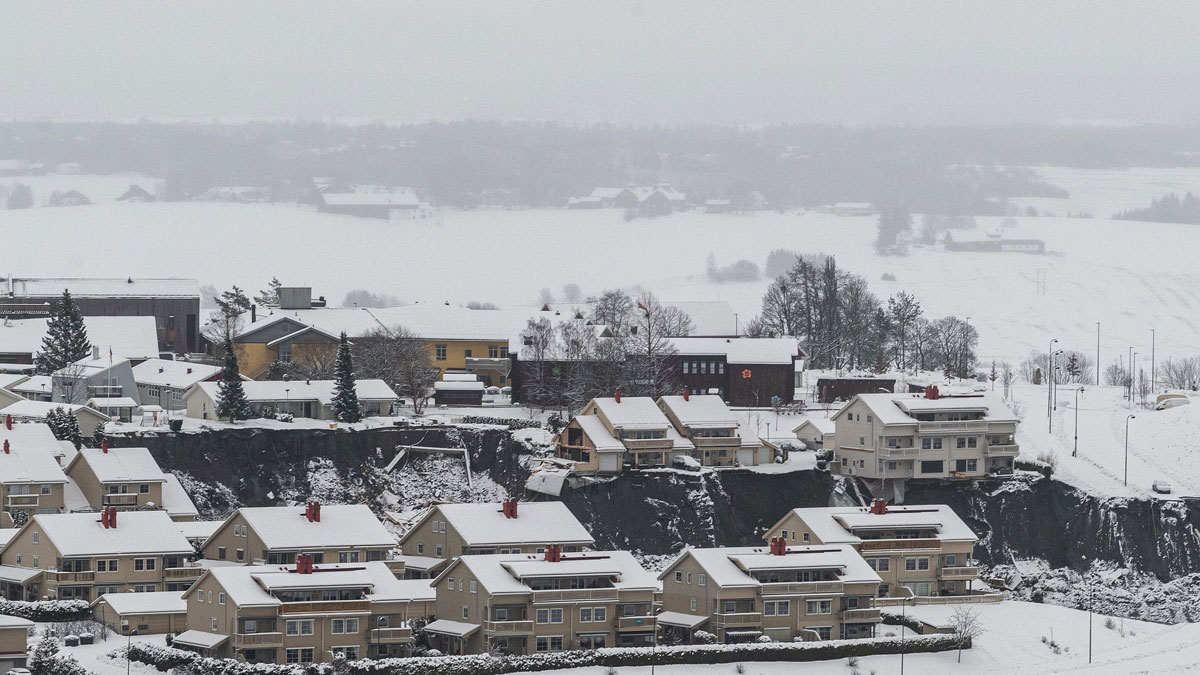
In countries of the far north, a particular kind of natural disaster can strike almost without warning. Quick clay landslides, in which previously solid soil suddenly liquefies, can carry away houses and farms and bury towns and roads. The slides occur when salts leach out from clay soils that were previously beneath sea level, eventually bringing the soils’ stability beneath a critical threshold and making them vulnerable to potential triggering events.
Striking examples in Norway include buildings sliding sideways into the sea near the northern town of Alta in 2020 and the Verdal landslide in 1893, in which 3 square kilometers of land broke loose in the central Norwegian municipality, killing 116 people and burying 105 farms. Quick clay (often called sensitive clay in North America) is also found in Alaska, as well as Canada, Finland, Russia, and Sweden, where governments often attempt to stabilize at-risk soils. Doing so can be expensive and environmentally harmful, leading researchers to seek better ways of making quick clay safe again.
“If we can understand how these salts are doing it, maybe we can find something else that does the same thing.”
In new research published in the Journal of Colloid and Interface Science, Norwegian researchers dove down to the microscopic scale to provide new insights into how different kinds of salts contribute to the mechanical strength of quick clay. The findings could reveal novel ways to make at-risk soils safe from slides, said study coauthor Astrid de Wijn, a materials scientist at the Norwegian University of Science and Technology (NTNU).
“If we can understand how these salts are doing it, maybe we can find something else that does the same thing,” she said.
For Want of Salt
The key statistic for quick clay risk is the marine limit—the line dividing soils that were previously below sea level from those that remained above it. In high-latitude countries like Norway, melting glaciers at the end of the last ice age, around 10,000 years ago, caused a process of unburdening and uplift called isostatic rebound that brought some previously submerged areas above water. The marine limit varies from place to place but can be more than 200 meters above current sea levels in the south of Norway and includes significant portions of the country.
The soil “will behave like sort of a sour cream. It just pours out of the landslide crater.”
Soils beneath the marine limit were infused with salts from the sea, which they’ve gradually lost over time from groundwater leaching. Those salt ions act as electrochemical binders between clay molecules, helping strengthen them, said Jean-Sébastien L’Heureux, a geotechnical engineer and technical expert on quick clay at the Norwegian Geotechnical Institute who was not involved with the research.
Without the salts to hold them, the microscopic particles of clay look more like a house of cards, stacked haphazardly with nothing binding them together. It is in this state that regular clay becomes quick clay, where even small perturbations like minor earthquakes or construction projects can cause devastating landslides. Previously solid soil “will behave like sort of a sour cream,” L’Heureux said. “It just pours out of the landslide crater.”
The main way to prevent such catastrophes is to stabilize the soil, a process that to date has typically involved injecting lime and cement to act as a binder. The technique is effective but environmentally unfriendly because of the large amounts of carbon dioxide (CO2) it creates. Coming up with an equally effective, more sustainable method is the goal of the Sustainable Stable Ground (SSG) project run by NTNU, which de Wijn and her coauthor, NTNU chemist Ge Li, are part of.
Using molecular dynamics simulations that re-create how clay molecules act at the nanoscale, the two researchers were able to compare how different salt cations affected the clay’s strength. The key difference was between divalent cations like magnesium chloride (MgCl2) and calcium chloride (CaCl2) and monovalent ones like sodium chloride (NaCl) and potassium chloride (KCl), Li said. Divalent cations enhance interactions between clay particles to a greater extent and stick out more, increasing friction. That means they enhance clay strength more than monovalent cations do and could offer a blueprint for future chemical stabilizers in quick clay.
In Search of Better Solutions
Finding a truly effective, affordable, and sustainable means of stabilizing quick clay will likely take some time, however. Priscilla Paniagua, a geotechnical engineer at the Norwegian Geotechnical Institute not affiliated with the paper, noted that simply adding more salt, as some projects have attempted to do, is unlikely to be effective, as current technology makes it difficult to scale. What’s more, the salt will simply leach out from the soils again, Li noted.
Some teams have proposed using materials like biochar or ash to stabilize soils, approaches that work well in the lab but have yet to be scaled up, Paniagua said. Another issue is that some proposed stabilization methods would increase only the remolded strength of quick clay, or its strength after it has liquefied and begun moving.
“It means that it won’t be quick [clay], but…you’re not increasing the full stability of the slope,” L’Heureux said. Such approaches would mitigate the impact of a quick clay landslide but wouldn’t prevent it from occurring.
Though challenges remain, Li and de Wijn remain hopeful that a better solution for quick clay is possible. Li said their modeling work is informing small-scale lab experiments testing how various materials affect soil strength. New proposals for stabilizers include polymers that enhance clay binding and even CO2 injected into the soil to help lime solidify, de Wijn said.
Today, better maps of quick clay landslide risk give local governments and developers more information about where it’s safe to build and where it isn’t. But with many soils destabilized, scientists note, the risk of landslides remains.
—Nathaniel Scharping (@nathanielscharp), Science Writer